Beyond the GH¢500b Target: A legislative blueprint to protect Ghana’s workforce (Part 2)
In Part 1 of this series, we examined the hidden risks facing Ghana’s digital expansion: the "AI Layoff Trap," the erosion of the white-collar PAYE tax base, foreign currency extraction via API licensing fees, and an entry-level talent crisis triggered by automated workplace workflows.
In Part 1 of this series, hidden risks associated with Ghana's digital expansion were outlined, including the "AI Layoff Trap," the decline of the white-collar PAYE tax base, foreign currency gains through API licensing fees, and a shortage of entry-level talent due to automated workplace workflows. As technological advancements continue, it is essential to recognize that human displacement is a deliberate choice influenced by public policy.
To build an inclusive economy, Ghana's National AI Strategy must prioritize workforce protection over accelerating graduate unemployment.
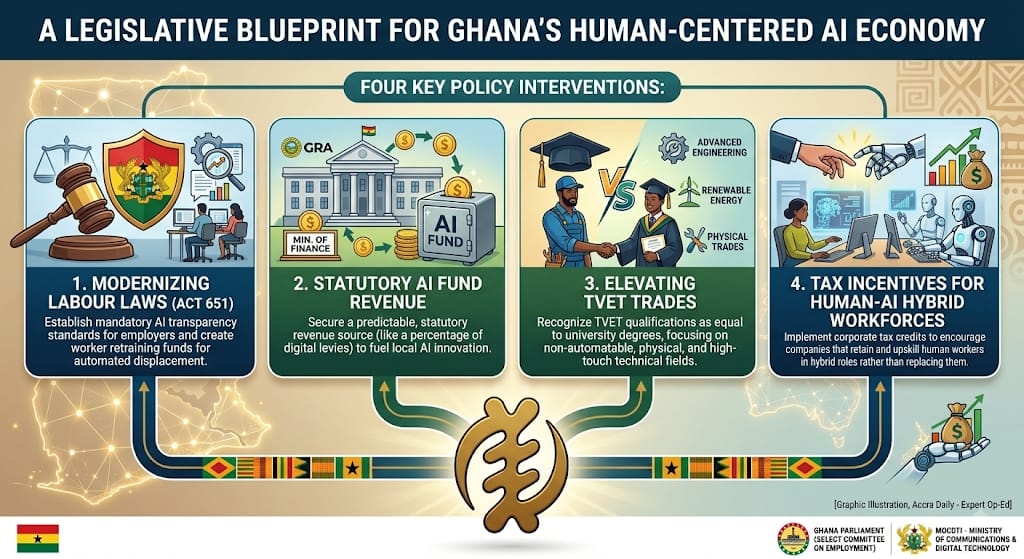
A Four-Point Policy Framework has been proposed to bridge the gap between Ghana's national strategy and the reality of the local workforce. These four structural levers include:
1. Updating Labour Legislation (Act 651) to specifically define "Algorithmic and Technological Displacement," requiring corporations to disclose AI integration progress, provide notice of workforce restructuring, and contribute to a co-financed national retraining fund for affected workers.
2. Establishing the National AI Fund with a fixed percentage of digital communications levies, ensuring consistent local venture capital for Ghanaian AI startups developing homegrown, locally hosted solutions.
3. Elevating Technical and Vocational Education and Training (TVET) funding, shifting focus from basic software coding to advanced industrial skills like industrial electrical engineering, renewable energy grid maintenance, and specialized mechanics.
4. Implementing tax incentives for companies adopting human-AI hybrid workflows, prioritizing the retention of junior talent and investment in internal mentorship programs over immediate workforce cuts.
Ghana now stands at a pivotal moment, where it can either become a passive recipient of imported automation, weakening its tax base and increasing graduate unemployment, or proactively shape its regulatory environment to safeguard human labor and foster local technological independence. The long-term success of Ghana's digital transformation will be evaluated not only by its GDP growth but by the policies' ability to create a stable, resilient economy where Ghanaian workers have the power to direct technology, rather than be replaced by it.
Written by urgent.news from MyJoyOnline Ghana's reporting — not their text. Machine-written — may contain errors; check the original before relying on it.