Allen County Historical Society and Museum in Lima, Ohio
If the entirety of this museum wasn’t so peculiar already, the James E. Grosjean Room at the Allen County Historical Museum would be a place of magic surrealism; a tactile portal to the past in the midst of the proverbial Rust Belt town built quickly on oil. Lima once had a bustling trolley system, the prominent Faurot Opera House, industry, culture and promise. But now it’s easy to see the…
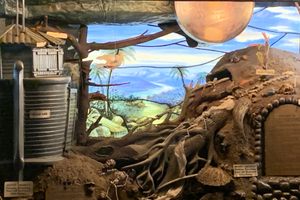
The Allen County Historical Society and Museum in Lima, Ohio, is a peculiar and magical place, particularly in the James E. Grosjean Room. This room serves as a tactile portal to the past, transporting visitors to a bygone era in the midst of Lima's Rust Belt decline. Lima once boasted a thriving trolley system, the Faurot Opera House, and a bustling industrial and cultural scene. However, the town now exhibits signs of decline, making the museum all the more special.
The museum, like many others, houses quilts, trains, natural history displays, and native artifacts. Yet, it stands apart due to its collection of archived dream state objects. In the Grosjean Room, the lights dim, and a schmaltzy soundtrack and filmstrip narration commence. A dove soars across a stained-glass background, and giraffes, Noah's Ark, and other animals join the display. This mechanical motion and light predates Disney's animatronics by decades but possesses the Midwestern hokum of folk art.
James E. Grosjean, the creator of this unique attraction, was a true polymath. He was an undertaker, shoe salesman, inventor, historian, and full-time innovator. Grosjean's first "spectacular display," a story of Cock Robin, was destroyed during the 1913 Dayton Flood. Nevertheless, his Noah's Ark, built in 1901, has had a storied history.
Initially displayed at Marshall Fields in Chicago, Macy's in New York, and his own Lima shoe store, it was even rejected by the Pan-American Exposition in Buffalo. Grosjean then set up his own exhibit in Niagara Falls, ultimately becoming the president of the Allen County Historical Society from 1915 until his death in 1938.
Written by urgent.news from Atlas Obscura's reporting — not their text. Machine-written — may contain errors; check the original before relying on it.