US Manufacturing Jobs: The Long Transition
The basic patterns of US manufacturing jobs are fairly well-known. Here’s a figure showing total US manufacturing jobs over the last half-century or so: more-or-less flat from the 1970s up through 2000, then a decline from 2000 to about 2010, and more-or-less flat since then. Part of what happened in the early 2000s was a … Continue reading US Manufacturing Jobs: The Long Transition The post US…
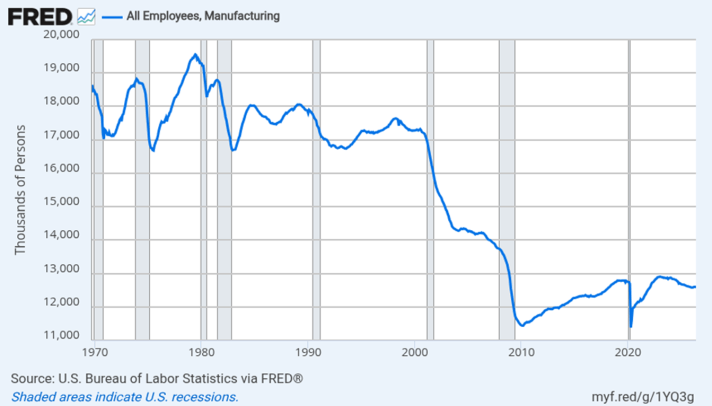
The United States has long relied on manufacturing jobs, but their role in the workforce has undergone a significant transformation over the past half century. Total US manufacturing jobs have been relatively stable since the 1970s, but a decline from 2000 to 2010 was followed by a plateau. This trend can be attributed to several factors, including increased imports from China following its entry into the World Trade Organization, a shift of US workers to the housing sector during the housing boom prior to the Great Recession, and the rise of robotics in manufacturing.
When considering manufacturing jobs in relation to the overall US economy, a different perspective emerges. In 1970, manufacturing jobs accounted for 26% of all US jobs, but by 2000, this figure had dropped to 13%. The decline in the share of manufacturing jobs in the US labor market is a gradual process that has accelerated since 2000. Vittoria Dicandia's analysis in "Manufacturing in the United States" (Federal Reserve Bank of Cleveland, September 21, 2026) provides further insight into the long-term trends.
One notable change is the education level of US manufacturing workers. The share of workers without a college degree has decreased, while those with college degrees have increased. Moreover, college-educated manufacturing workers enjoy a modest wage premium, while their non-college counterparts do not. The traditional narrative holds that while the number of manufacturing workers remained constant, their productivity grew substantially.
However, this story has changed since the late 2000s, as productivity growth in manufacturing has been slightly negative since 2007.
Another factor contributing to the shift in manufacturing jobs is the adaptation of the US workforce. With fewer manufacturing jobs, younger workers are less likely to enter the sector. Consequently, US manufacturers face a shortage of workers despite their desire to increase production. To attract more workers, employers could consider raising wage premiums. Overall, the story of US manufacturing jobs is one of a long-term transformation, requiring adaptation from both employers and the workforce.
Written by urgent.news from Conversable Economist's reporting — not their text. Machine-written — may contain errors; check the original before relying on it.