Puerta del Hospital de la Latina in Madrid, Spain
There is something delightfully disorienting about stumbling across a 500-year-old Gothic doorway in the grounds of Madrid’s School of Architecture. Surrounded by modern university buildings and the comings and goings of students, the ornate stone portal looks as though it has taken a wrong turn somewhere in the city. In fact, it has—but quite a long time ago. Known as the Puerta del Hospital de…
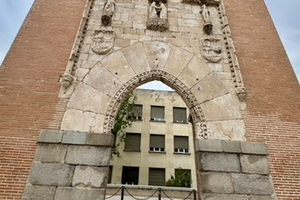
In the heart of Madrid’s bustling city, a striking 500-year-old Gothic doorway has become a remarkably resilient relic. Known as the Puerta del Hospital de la Latina, this ornate stone portal is the lone surviving entrance to the Hospital de la Concepción de Nuestra Señora, which was established in 1499 by Beatriz Galindo and her husband, Francisco Ramírez.
Galindo, a renowned scholar of Latin and former tutor to the royal children of Isabella I of Castile, earned her nickname “La Latina,” which in turn became the namesake for both the hospital and a prominent neighborhood in Madrid.
The Hospital de la Latina stood proudly at the intersection of Calle de Toledo and Plaza de la Cebada, within the very center of what is now the La Latina district. Its architectural beauty was a captivating blend of flamboyant Gothic design and Mudéjar influences, credited to the skilled hands of master craftsman Hazan. The intricate entrance featured a striking pointed arch, delicate Gothic canopies, heraldic shields, and a range of sculptures, including a captivating biblical scene depicting the embrace of Saint Joachim and Saint Anne before the Golden Gate.
The hospital thrived for more than four centuries, even serving as a military hospital during the tumultuous Peninsular War. However, Madrid’s relentless desire for wider streets eventually surpassed its appreciation for medieval architecture. In 1904, the hospital and the adjacent Convent of the Concepción Francisca succumbed to the urban expansion, as Calle de Toledo was widened to accommodate the growing city.
This tragic loss almost claimed the iconic doorway as well, but it managed to escape demolition. For several decades, the dismantled portal was stored in municipal collections before architect Fernando Chueca Goitia saw potential in its rejuvenation.
In the late 1950s, Chueca Goitia devised a plan to give the portal a new lease on life. The elaborate design was painstakingly restored and reconstructed, this time nestled beside the School of Architecture in the Ciudad Universitaria—a distance of several kilometers away from its original site. To conceal its past, a new brick structure and tiled roof were added behind the portal, transforming a fragment of a vanished hospital into a freestanding architectural time capsule.
Today, the Puerta de la Latina enjoys a surprisingly tranquil existence, far removed from its medieval origins.
Once welcoming patients on a bustling medieval street, the doorway now stands amidst trees and university buildings, silently observing generations of architecture students hurrying by. While it has lost its hospital, convent, street, and even its neighborhood, the Puerta de la Latina has managed to retain its front door—a remarkable testament to the enduring power of architectural history.
Written by urgent.news from Atlas Obscura's reporting — not their text. Machine-written — may contain errors; check the original before relying on it.