President Mahama urges Ghanaians to embrace Nkrumah’s legacy and advance nation-building
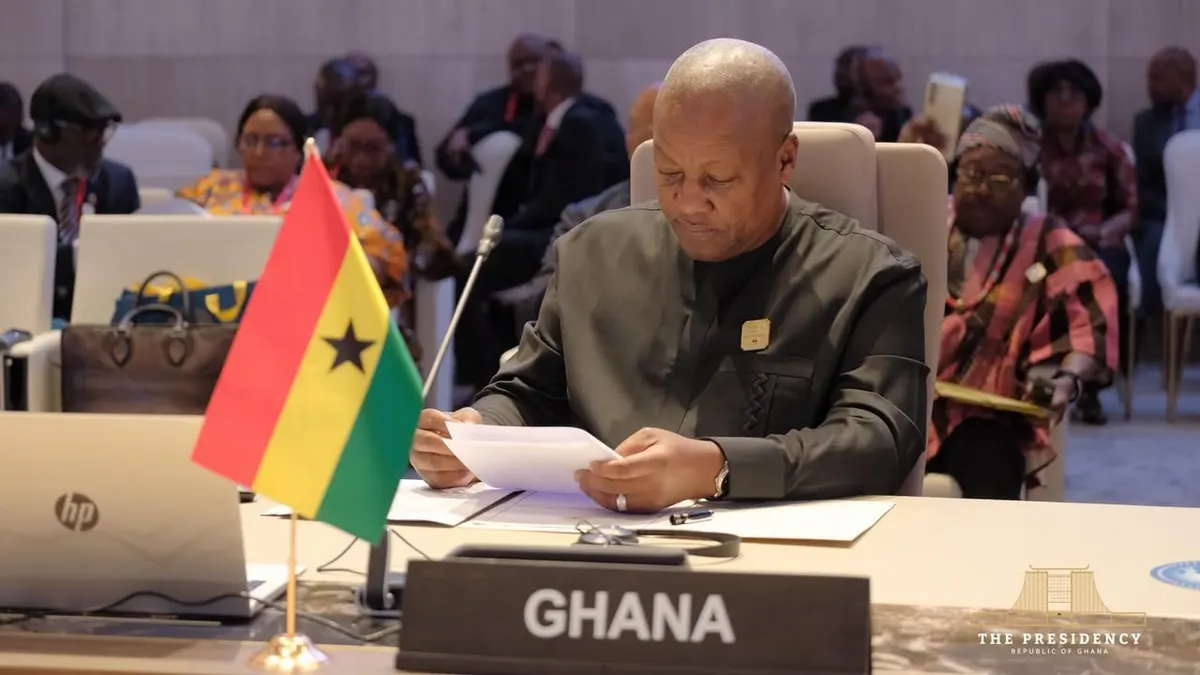
In his Founder’s Day message, President John Dramani Mahama has called on Ghanaians to reflect on Dr. Kwame Nkrumah’s vision for unity, self-reliance, and economic freedom.
Veteran journalist and Pan-Africanist Kwesi Pratt Jnr has urged Ghana to revisit Dr Kwame Nkrumah's Seven-Year Development Plan from 1963 to 1970 as it addresses the nation's ongoing economic struggles. Pratt, who delivered the 15th Kwame Nkrumah Memorial Lecture at the University of Cape Coast, emphasized that the plan provided a comprehensive vision for transforming Ghana's post-independence economy.
The plan, which Pratt described as one of the most comprehensive attempts by a post-independence government to change the colonial economic structure and lay the foundation for economic independence, focused on six key areas: state-led industrialization, economic diversification, agricultural modernization, infrastructure development, human capacity development, and African economic purpose.
Nkrumah recognized that political independence alone was insufficient, given Ghana's heavy reliance on exports of cocoa, gold, timber, and other raw materials, and the importation of manufactured goods. To address this, Pratt said Nkrumah pursued state-led industrialization, creating state enterprises in manufacturing, agriculture, transportation, and hospitality sectors.
He also highlighted industrial diversification as a strategy to reduce vulnerability to fluctuations in global commodity prices and create employment within the national economy. The plan's infrastructure investments, such as the Akosombo Dam and Volta River Project, Tema Harbour, roads, and electricity, aimed to establish a foundation for productive economic activity.
Pratt also underscored Nkrumah's emphasis on education and human capacity development, with the expansion of primary, secondary, technical, and university education aimed at producing a skilled workforce for national development. He noted that the establishment of the University of Cape Coast was an integral part of this broader development strategy.
Despite facing significant challenges, such as collapsing cocoa prices, increased external debt, and administrative weaknesses, Pratt emphasized that abandoning national planning or industrialization was not the solution. Instead, he called for stronger management, accountability, technological competence, realistic sequencing, and disciplined evaluation.
Pratt also rejected the notion that Nkrumah destroyed Ghana's economy upon becoming President, asserting that he inherited a dependent commodity-export economy and attempted to transform it, ultimately creating significant national assets.
Written by urgent.news from GBC Ghana's reporting — not their text. Machine-written — may contain errors; check the original before relying on it.
This story
This is one outlet's version. Read the fullest account.