Märkte: Insider – China bremst Börsengänge von Roboter-Herstellern
Chinesische Aufsichtsbehörden prüfen wegen hoher Bewertungen mehrere geplante Börsengänge von Roboterfirmen. Auslöser ist laut Insidern unter anderem der volatile Börsenstart von Unitree Robotics.
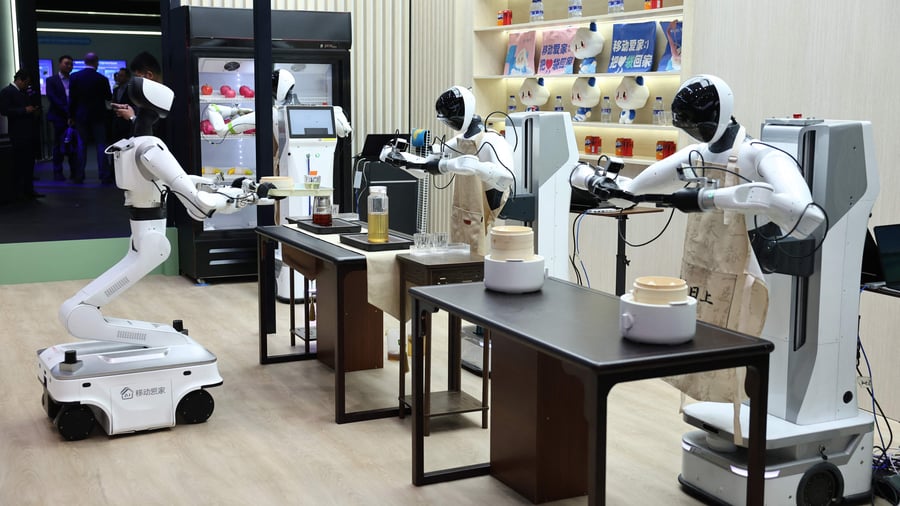
Chinese regulatory authorities are slowing down the surge of humanoid robot manufacturers into the stock market, according to insiders. They are investigating whether the significant valuation increases and revenues from state-supported projects correspond to genuine commercial demand. The slowdown is mainly due to the volatile initial public offering (IPO) of robot manufacturer Unitree Robotics, according to several people familiar with the matter.
The stock skyrocketed more than fivefold on its debut in Shanghai a month ago, only to fall by 55 percent since its peak. The oversight bodies have reportedly held back several robot manufacturer IPOs through informal instructions. Beijing's government has declared "embodied intelligence" – AI systems that can perceive and act in the physical world – as an emerging strategic industry, prompting private capital and regional government investments.
Leo Wang, a venture capitalist at Qianchuang Capital, described the investment wave in the robotics sector as "campaign-style innovation." This hype has led some founders to attract dozens of potential investors within weeks and reject usual diligence checks. At least six Chinese robotics companies are preparing for an IPO, including Deep Robotics, X Square Robot, and Agibot.
The oversight authorities are particularly focused on whether the revenues from state-supported projects, such as robot data centers for training machines, are sustainable. Such projects can provide orders that support valuations on the private market and help companies reach the thresholds for an IPO. However, the oversight authorities question whether these revenues represent demand from independent customers.
The valuations of some robot firms could drop by 60 to 70 percent if the revenues tied to the data centers are taken into account. Despite the stricter oversight, Beijing's push into humanoid robotics is not waning, according to executives and investors. It reflects a growing emphasis on practical deployment, order volume, and proof that companies can turn technical demonstrations into commercially viable products.
Investor sentiment has shifted from "blanket euphoria to selective rationality," said Ruiying Zhao, an analyst at S&P Global Market Intelligence. "What is the purpose? Are the robots just dancing? Are they working in factories?" said a banker involved in Asian equities. "The volume has not really kept pace with the hype."
Written by urgent.news from Handelsblatt's reporting — not their text. Machine-written — may contain errors; check the original before relying on it.