China gets closer to Jupiter mission by bringing Nasa’s StarNAV concept to life
Chinese researchers have tested a new way for spacecraft to navigate in deep space, putting a concept funded by Nasa into practice and paving the way for the country’s planned mission to Jupiter in 2030. Known as stellar aberration navigation, the approach uses tiny shifts in the relative position of stars to work out how fast a probe is moving and in what direction, allowing autonomous real-time…
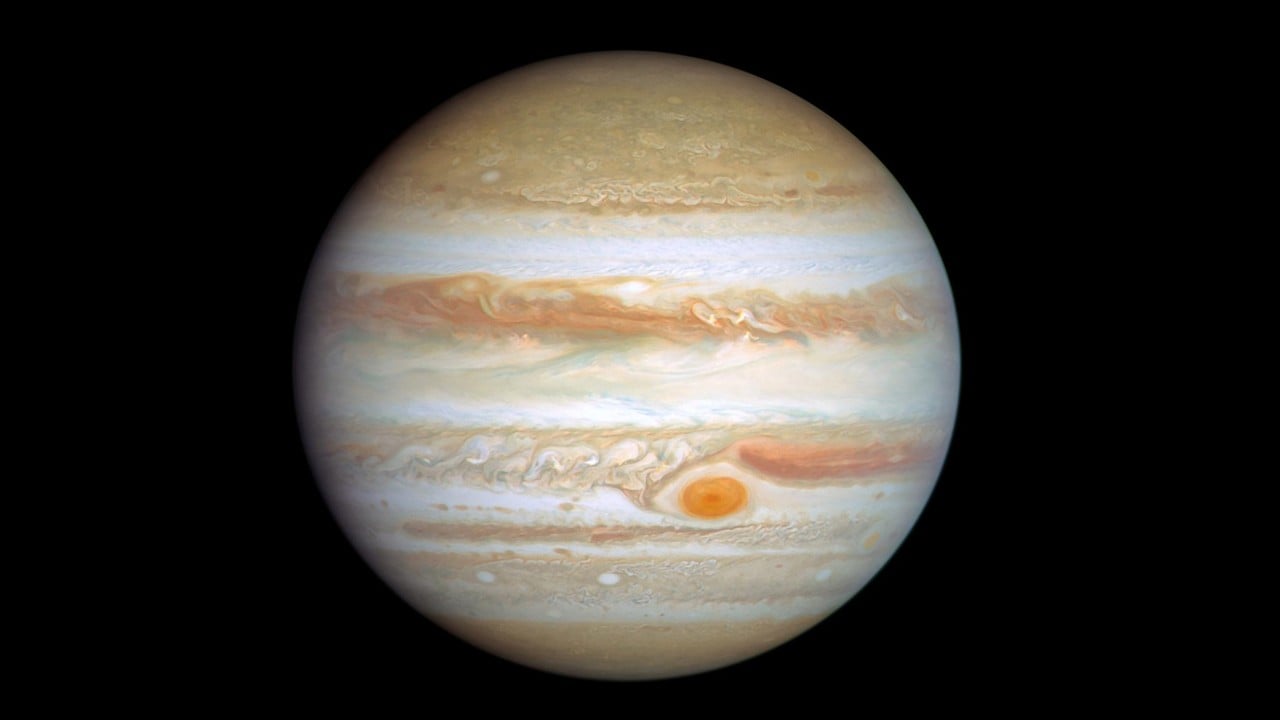
Chinese scientists have successfully tested a new navigation method for deep space probes, inspired by a concept supported by NASA. This technique, known as stellar aberration navigation, relies on minute shifts in the position of stars to determine a spacecraft's speed and direction, enabling autonomous real-time navigation without constant communication from Earth.
A January experiment aboard the Tianhui-7 satellite demonstrated the method's effectiveness, accurately pinpointing the probe's location within 5km (3.1 miles), comparable to NASA's Deep Space Network. Given Jupiter's average distance of 900 million km from Earth, real-time ground control is impractical due to the 50-minute radio transmission delay.
While China can monitor spacecraft at similar distances, the precision of its tracking lags behind that of NASA and the European Space Agency. The Tianwen-4 mission, China's inaugural endeavor to explore the Jupiter system, aims to study the planet and its moons, including their formation, environment, and internal structures. In January 2025, Tianhui-7 was launched aboard a Long March 4B rocket from the Jiuquan Satellite Launch Centre in northwest China, with its primary mission being geographic mapping, land surveys, and scientific research.
Carrying three highly precise star cameras and an infrared sensor, the satellite conducted a 20-hour orbital test around Earth at a distance of 500km. By photographing different sections of the sky and observing Earth using the infrared sensor, the cameras and infrared sensor enabled the satellite to determine its position and velocity.
The researchers later validated the method's accuracy against GPS data. Stellar aberration, the apparent shift of stars due to Earth's movement around the sun, was first discovered by English astronomer James Bradley over 300 years ago. Though initially considered an error in star measurements, scientists later recognized its potential as a navigation tool.
By quantifying the degree of star displacement, researchers can determine a spacecraft's speed and direction. In 2020, NASA funded the StarNAV project, which aimed to measure stars precisely enough for navigation by starlight. The star cameras onboard Tianhui-7 achieved an accuracy of about 50 milliarcseconds, while an optical reference system corrected any systematic errors caused by vibrations and temperature variations during the 20-hour test.
Although the technique's performance around Jupiter remains uncertain, China is developing more precise star cameras capable of measuring shifts in milliarcseconds. A prototype of these advanced cameras has already undergone ground tests.
Written by urgent.news from South China Morning Post's reporting — not their text. Machine-written — may contain errors; check the original before relying on it.