Archaeologists Are Reconstructing the Invisible Technologies of the Stone Age, From Rope to Thread and Twine
Largely missing from the archaeological record, fiber innovations played a huge role in the lives of early humans. Researchers are weaving together new insights from the traces they left behind
In 2015, archaeologists discovered a nearly eight-inch rod with four perforations in southern Germany's Hohle Fels cave. Initially thought to be a symbolic object, further examination revealed spiral grooves lining each hole. Nicholas Conard, the lead archaeologist, hypothesized that the rod was a tool used to twist other materials through its perforations.
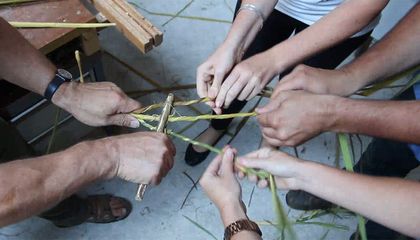
When his team tried threading cattail fibers through the holes, they discovered that the grooves helped orient the strands, successfully weaving them into 16 feet of strong rope.
While this discovery shed light on a specific aspect of prehistoric life, it also highlighted a broader issue. The inhabitants of Hohle Fels must have produced vast quantities of rope, yet none of it has survived to the present day. Archaeologists typically rely on stone tools and bone artifacts to reconstruct prehistory, as these materials are more durable. However, objects made from plant and animal products, such as rope, have largely been overlooked due to their fragility.
Despite this bias in the archaeological record, soft technologies like rope played a crucial role in shaping the lives of our ancestors. Emma Finestone, a paleoanthropologist, explains that archaeologists must account for the vast majority of daily activities that involved soft technologies, many of which we don't consider. The oldest surviving example of human-made fiber dates back about 50,000 years to a six-millimeter-long string created by Neanderthals at the Abri du Maras rock shelter in France.
This finding suggests that fiber technology has deep roots in human history, potentially reaching back more than half a million years.
The oldest evidence of fiber use dates back about 250,000 years, inferred from markings on stone tools found in France and the Netherlands. These markings indicate that the tools may have been hafted, or attached to a handle using some type of string or cord. This connection between tools and cordage fundamentally changed the way prehistoric humans utilized their technology, allowing for new possibilities in tool use and expanding the capabilities of prehistoric humans.
Cordage, such as rope, string, and twine, was transformative in that it connected other technologies, enabling prehistoric humans to build, carry, and hunt more effectively. For example, hafting a sharpened stone point onto a wooden shaft allowed the point to become a more effective hunting weapon. Similarly, stone handaxes could be wielded with greater force and from a wider range of angles when fastened onto a handle.
The ability to transport heavy stone tools over long distances would have been significantly aided by the use of cordage, as bare-handed transport would have been cumbersome.
Soft technologies also enabled passive hunting methods, such as setting up snares and nets while the hunter-gatherer focused on other tasks. Rock art from around 7,500 years ago even depicts people climbing rope ladders to access beehives, illustrating how fiber technologies opened up new foraging opportunities. Once the technology of cordage was mastered, humans became increasingly dependent on it, as it played a vital role in various aspects of their daily lives.
Written by urgent.news from Smithsonian's reporting — not their text. Machine-written — may contain errors; check the original before relying on it.