A Rare Aztec Codex Detailing the Rise and Fall of Tenochtitlan Returns to Mexico for the First Time in Nearly Two Centuries
The artifact, among the most prized visual accounts of Aztec history, will be on display in Mexico City for three months
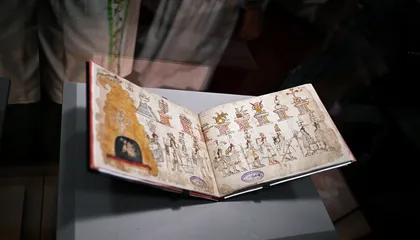
For the first time in nearly two centuries, a rare Aztec codex detailing the rise and fall of Tenochtitlan has returned to Mexico. Displayed at the National Museum of Anthropology in Mexico City, the centuries-old manuscript is officially known as the Azcatitlan Codex. Created between the late 16th and early 17th centuries, the relic comprises 50 folios that blend European writing with Mesoamerican illustrations to depict the Mexica migration from Aztlán, the reigns of Tenochtitlan's rulers, and the Spanish conquest and evangelization.
Tenochtitlan, the modern-day Mexico City, was established as the Aztec capital in 1325 by hunter-gatherers residing along the shores of Lake Texcoco. At its zenith, under the guidance of Montezuma II, the empire stretched from contemporary Nicaragua to Mexico City, boasting a population of five to six million inhabitants. The Spanish conquistadors, led by Hernán Cortés, arrived in Tenochtitlan in 1519 and, two years later, the Aztec Empire fell.
The Azcatitlan Codex, a visual account of Aztec history, is considered one of the most valuable artifacts of Aztec civilization. Its return to Mexico has reignited the debate over its ownership, which has been contested for centuries. Originally held by historian Fernando de Alva Ixtlilxóchitl, a descendant of Nezahualcóyotl, the codex passed through several scholars and libraries before being acquired by French collector Eugène Goupil in Paris around 1898.
Since then, the codex has been under French government ownership, and both France and Mexico claim to be its rightful owners. In 1982, another Mexican lawyer, Jose Luis Castaneda, successfully returned a codex, the Codex Tonalamatl, to Mexico. Despite tensions, the Mexican government will not attempt to reclaim the Azcatitlan Codex while it is in Mexico City, viewing its temporary return as a symbolic gesture celebrating 200 years of Franco-Mexican diplomacy.
The codex, temporarily displayed under protective glass in the MNA, features pages depicting eight distinct Indigenous peoples searching for Tenochtitlan, under the guidance of the Aztec sun and war god Huitzilopochtli.
Written by urgent.news from Smithsonian's reporting — not their text. Machine-written — may contain errors; check the original before relying on it.