EDUCATION ON HOLD: How Poverty Is Stealing Nigerian Children’s Future
At a busy roadside in Kuje Area Council of the Federal Capital Territory (FCT), 17-year-old Ismaila Abdulahi moves from one vehicle to another, holding out his goods to motorists and pedestrians. For him, school is not a place he remembers leaving. It is a place he has never known. “I have never stepped into the […]
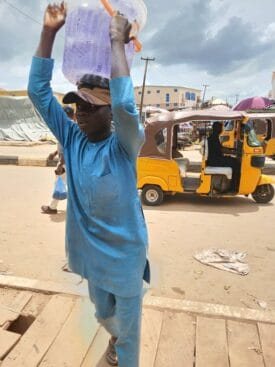
In a bustling spot on the outskirts of Abuja, 17-year-old Ismaila Abdulahi engages in hustling, showcasing his wares to passing motorists and pedestrians. School is not a place that this young man recalls having attended, as it holds no significance in his life. "I never stepped foot in a classroom," he shares, having moved to Abuja from Kano at the tender age of 11 in pursuit of survival opportunities.
Ismaila's plight mirrors those of countless other children across Nigeria who find themselves engaged in laborious tasks, such as peddling beverages, food, household items, and other goods, working as domestic helpers, or assisting their parents in markets. Some are so young that the very concept of a future beyond survival seems incomprehensible, while others have already learned that childhood takes a backseat to the struggle for daily sustenance.
As the sight of children on the streets during school hours becomes increasingly commonplace in Nigerian cities, it risks becoming normalized. However, every child seen carrying goods under the blistering sun or hawking goods at traffic lights bears a story rooted in poverty, family pressure, displacement, migration, cultural practices, insecurity, or a combination of these factors.
The ramifications of this issue extend far beyond the individual child. Nigeria's education crisis continues to be one of the nation's most enduring development challenges. According to UNICEF's 2025 Annual Report, released in April 2026, there are 10.2 million children out of school, with 45% of them residing in the North-West and 28% in the North-East.
The report also reveals that 70% of Nigerian children and young people aged three to 24 attend school, with attendance significantly lower in rural areas compared to urban communities. Ismaila's journey from Kano to Abuja at the age of 11 in search of survival opportunities is not unique. Musa Abubakar, another teenager interviewed in Kuje, has been traveling to Abuja via trailers from Zaria for approximately four years.
He attended a Tsangaya school but dropped out due to the overwhelming pressure. "The pressure was too much," he explains. This highlights another aspect of Nigeria's out-of-school crisis, where the separation of education from the economic and social circumstances surrounding children proves challenging. While Islamic education remains significant for many families, experts and stakeholders emphasize the need for children to have access to basic formal education and the skills necessary to thrive in modern society.
For children who have spent their formative years outside classrooms, the consequences can be severe. They may struggle with reading and writing skills, face limited employment opportunities later in life, and remain trapped in the same cycle of poverty that led them to abandon school in the first place. According to UNICEF, children from impoverished households, children in street situations, displaced children, girls, and children affected by emergencies are particularly disproportionately affected by Nigeria's education crisis.
For some parents, sending their children to school is not merely a matter of willingness but a daily decision involving school fees, food, rent, transportation, and other essential needs. Mrs. Aisha Abubakar, a mother interviewed by Daily Trust, recounts how life became increasingly difficult for her family after her husband's passing.
She was responsible for paying her three children's school fees alone, finding it unsustainable due to the mounting pressure of house rent. Consequently, she had no choice but to withdraw her children from school. Another parent, Rashida Usman, enrolled her children in a public secondary school but struggled to meet the financial demands of their education.
She had to enroll her daughter in the market during her breaks to contribute to school fees, acknowledging the daily struggle and the government's limited assistance in alleviating the burden. Olatunji Bello, a commercial motorcyclist, shares his experience of rising costs in running his business, making it increasingly challenging to provide for his family and meet educational expenses.
This scenario underscores a broader issue: when household income fails to keep pace with the cost of living, education often becomes one of the first expenses families must prioritize. While poverty is undoubtedly a significant factor, it is not the sole reason children remain outside the classroom. Mrs. Olaniyan Folashade, from the FCT Secondary Education Board's School Services Division, acknowledges the existence of many out-of-school children and points to the need for a broader understanding of the problem.
She notes that schools often have teachers but no students, attributing this to infrastructure challenges, such as inadequate furniture in some classrooms and poor physical conditions in others. Mrs. Olaniyan believes that the responsibility for re-enrolling children in school cannot solely be shouldered by the government. She advocates for the involvement of the private sector, private organizations, and individuals through scholarships and other interventions.
She emphasizes that poverty is only one aspect of the issue, and a multifaceted approach is necessary to address the root causes of the education crisis in Nigeria.
Written by urgent.news from Daily Trust's reporting — not their text. Machine-written — may contain errors; check the original before relying on it.