Spanish economy transforms from crisis casualty to growth leader: QNB
For the years immediately following the Global Financial Crisis, Spain was emblematic of Europe's economic malaise. In the aftermath of a collapsed housing bubble and the euro area sovereign debt...
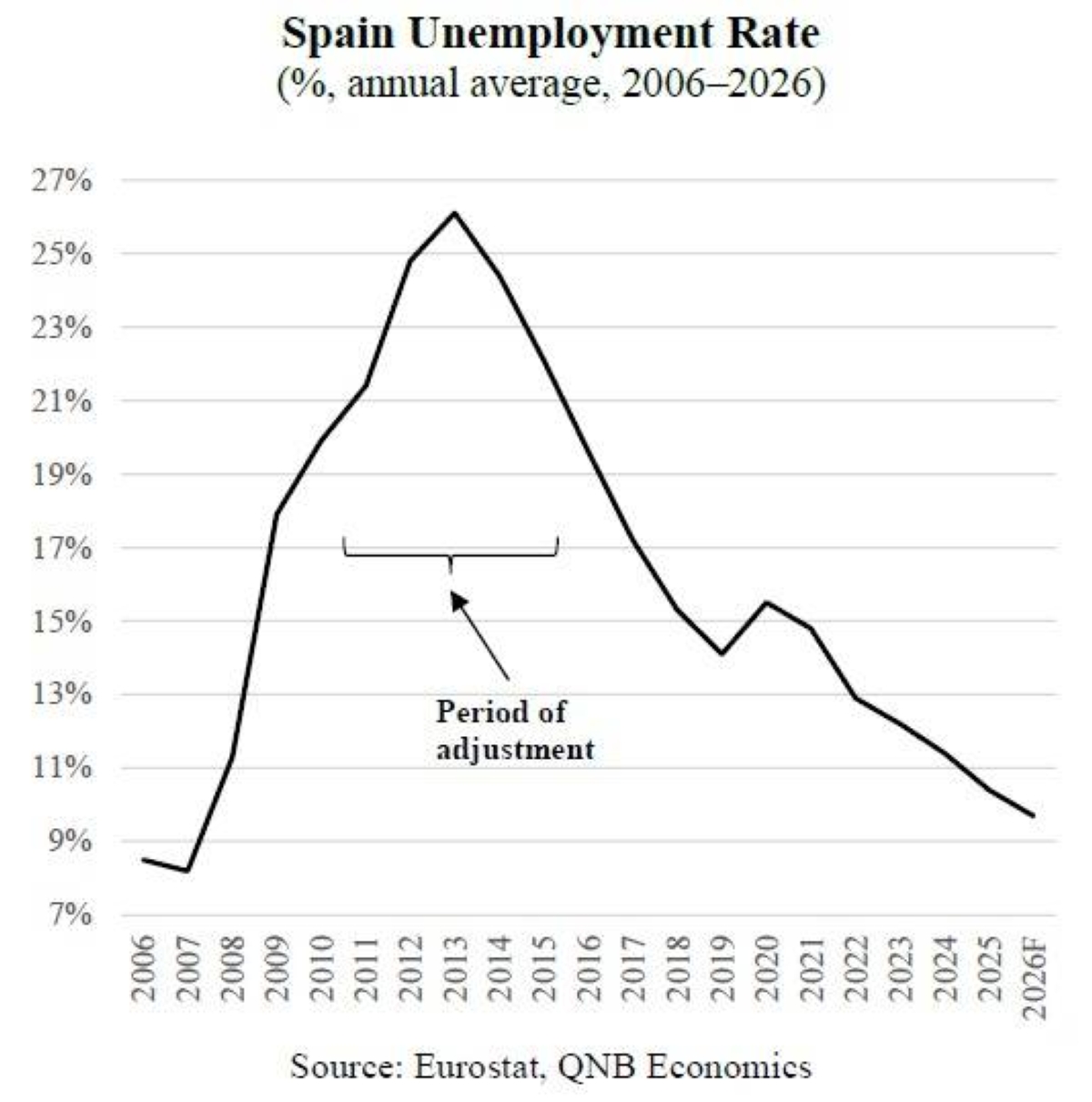
Following the Global Financial Crisis, Spain served as a prime example of Europe's economic struggles. The country faced a collapsed housing bubble, a sovereign debt crisis, and a peak unemployment rate exceeding 26% in 2013. The banking system required a substantial €100bn rescue, and the public deficit had ballooned to double digits.
Fast forward to 2024 and 2025, and the narrative has transformed dramatically. Spain is now among the top-performing advanced economies, with growth rates of 3.2% and 2.8% respectively, significantly surpassing the euro area's modest growth of just over 1%. It is projected to continue leading the currency bloc in 2026. The remarkable turnaround is attributed to a blend of diligent structural adjustments and advantageous tailwinds that have redefined Spain's growth model.
Three key factors underpin Spain's transformation: a more competitive and diversified export base, a resurgence in the demographic and labor market, and supportive investment and energy dynamics. Post-crisis adjustments bolstered competitiveness and broadened the export base. Sweeping labor market reforms introduced stable, permanent employment, while wage moderation lowered unit labor costs, enhancing Spanish firms' international competitiveness and stimulating an export recovery.
The government's restructuring and merging of fragile regional savings banks stabilized the financial sector. Moreover, Spain became a prominent hub for foreign greenfield projects and tech talent, supported by digital nomad initiatives. These enhancements elevated Spain's economy to higher-value-added services exports, including finance, information technology, and professional services.
A demographic and labor-market revival emerged as a powerful engine for growth. While the Global Financial Crisis led to the destruction of over three million jobs, employment rebounded to record highs, and unemployment, though still high, has dropped to around 10%—less than half of its 2013 peak. A significant driver has been the immigration of highly skilled labor, predominantly from culturally adjacent Latin America.
This influx expanded the working-age population and labor force during a period when much of Europe was aging and contracting. The influx of workers also bolstered consumption, alleviated skilled labor shortages, and heightened the economy's overall growth potential, contributing to some of the strongest productivity gains among Europe's largest economies in recent years.
Supportive investment and energy dynamics further reinforced the recovery. Spain benefits substantially from the European Union's post-pandemic recovery program, which injects significant funds into investment and modernization throughout the economy. Simultaneously, Spain's substantial investment in renewable energy and limited reliance on imported gas protect it from the worst of the recent energy price shocks that have adversely affected more energy-dependent neighbors like Germany.
Coupled with healthier household and corporate balance sheets resulting from years of deleveraging, these factors have fueled robust domestic demand while keeping public finances on an improving trajectory, with the debt ratio gradually declining.
In summary, Spain's evolution from a crisis casualty to a growth leader exemplifies how structural reforms, diversification, and favorable tailwinds can collectively reshape an economy's trajectory. Despite enduring challenges such as persistently high unemployment, an elevated debt-to-GDP ratio, and the challenge of sustaining strong productivity growth over the long term, Spain's journey stands in stark contrast to its crisis-stricken past.
It serves as a testament to the continent's most adversely affected economies' potential for durable recovery through time and reform.
Written by urgent.news from Gulf Times Business's reporting — not their text. Machine-written — may contain errors; check the original before relying on it.