Migration: Mehrheit der Anträge durch Asylrechtsreform im Schnellverfahren
Die neuen EU-Asylregeln bringen beschleunigte Verfahren für viele Antragsteller. Wer abgelehnt wird und dagegen klagt, kann schon abgeschoben werden, bevor das Gericht entschieden hat.
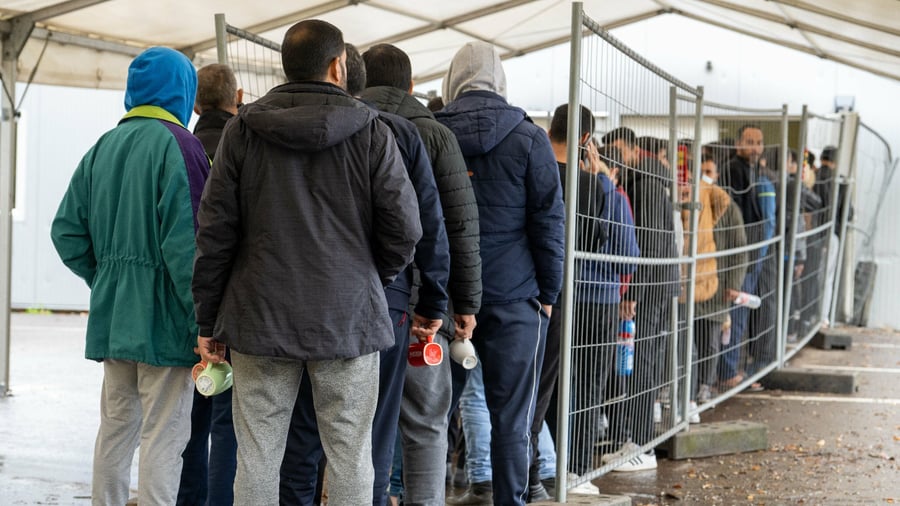
Since the new Asylum Rules of the European Union have been in effect, the majority of protection requests in Germany have been decided through expedited procedures. According to the federal government's response to a parliamentary inquiry from the Left fraction, between the reform's implementation on June 12 and the end of July, there were 2,093 expedited asylum procedures and 1,561 regular asylum procedures initiated.
In 2013, additional procedures only sought to determine which other EU country might be responsible for the applicant. The expedited procedures must be completed within three months according to the reform of the Common European Asylum System (CEAS). The new EU Asylum Procedures Regulation allows for expedited procedures for people from safe countries of origin or countries whose EU-wide recognition rate is at most 20 percent.
Those rejected in the expedited procedure can also be deported even if their appeal against the rejection is still pending in court. Preventing deportation in such cases is only possible if a pre-trial request for provisional legal protection is successful. Before the reform, people mainly came from states classified as safe in Germany, but also asylum seekers whose applications were viewed as not obviously unfounded for other reasons, such as contradictory identity, origin, and flight reason information.
The extension of the three-month period is not allowed. If the Federal Office for Migration and Refugees (Bamf) finds in each individual case that the examination of the application includes complex issues that are too complex to be resolved in the expedited procedure, a switch to the regular procedure is possible, as stated by the federal government.
Those classified as coming from a safe country in the expedited procedure are subject to an employment ban by default. The spokesperson for the Left fraction, Clara Bünger, expects: "Due to the short time, there will likely be more incorrect decisions." She also criticizes that Turkey "despite the massive persecution of opponents and obviously politically motivated court proceedings" is now considered a so-called safe country of origin according to EU rules.
The refugee rights organization Pro Asyl criticizes: "The federal government is implementing the new European standards strictly and far-reaching." Among the countries with a particularly high protection rate in the first half of this year, according to the federal government, were Myanmar, Eritrea, Afghanistan, and the Palestinian Territories.
Border procedures are rare in Germany. New are the so-called border procedures for people detected at an EU external border, which in Germany only concerns airports and seaports. People who have forged their identity, foreigners posing a danger, and people from countries with at most 20 percent EU-wide protection rate in their asylum application are housed in facilities they can leave only for the purpose of departure during the ongoing procedure.
Unaccompanied minors are exempt from the border procedure if they pose no security risk. Four locations for border procedures in Germany are new: 200 places in Frankfurt am Main, 27 places in Munich, 40 places next to Berlin/Brandenburg Airport, and 15 places temporarily in Pforzheim for arrivals at Stuttgart Airport until another location is found.
Further places and locations are being checked, built, or planned. Between June 12 and August 21, according to the federal government, 36 border procedures were completed, including five Brazilian nationals and four Georgians. 22 applications were rejected. In the first weeks, according to the information, four people from Ghana, Senegal, Colombia, and Morocco were denied entry due to a border procedure.
It can be assumed that the number of border procedures in countries like Poland, Greece, Spain, and Italy is significantly higher. How many asylum border procedures have been initiated and completed in these border countries since June 12 cannot be reliably estimated from the currently published statistics. Federal Interior Minister Alexander Dobrindt (CSU) has repeatedly emphasized that functioning procedures at the EU external borders are a prerequisite for a perspective to end the intensified internal German border controls. More: Why are more and more Germans moving to Poland?
Written by urgent.news from Handelsblatt's reporting — not their text. Machine-written — may contain errors; check the original before relying on it.