Landtagswahl in MV: Was man über die Wahl im Nordosten wissen sollte
Mehr als 1,3 Millionen Menschen in Mecklenburg-Vorpommern dürfen mitbestimmen, wer künftig das Land regiert. Wer wählen darf, wie die Wahl abläuft und warum es diesmal besonders spannend ist.
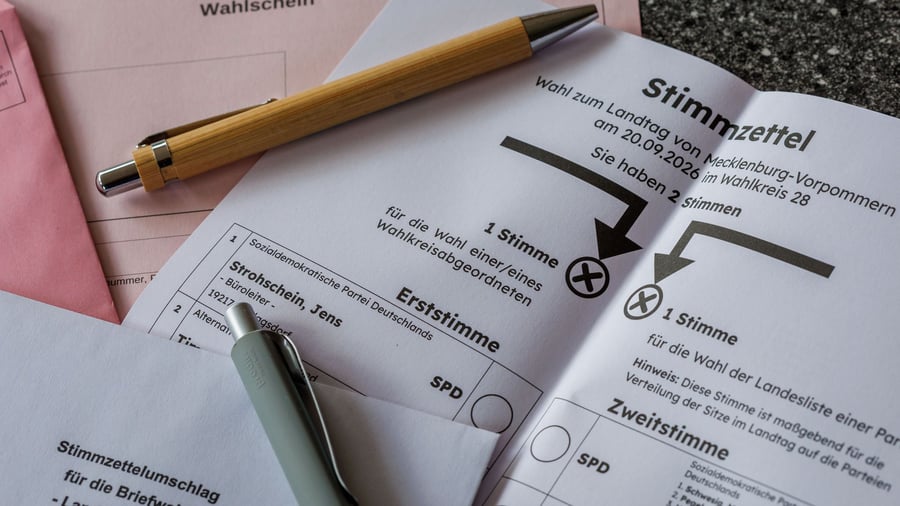
Mecklenburg-Western Pomerania holds its Landtag election on Sunday, with the outcome carrying significant implications. Nearly 1.3 million eligible voters will decide which parties and individuals will represent them in the 9th Schweriner Landtag. The voting process involves both a first and second vote. The first vote selects direct candidates for the parliament, while the second vote determines the party and its Landesliste, which influences the number of seats the party holds in the legislature.
To be eligible to vote, one must have a German passport and be registered in the region for at least 37 days. Notably, voting now begins at the age of 16. Only parties securing at least five percent of valid votes will be considered to prevent a fragmented parliament. The election concerns 71 parliamentary seats, with potential additional seats due to overhang or balance mandates.
The candidates include the SPD, AfD, CDU, Linke, Grüne, FDP, and several smaller parties like the BSW, Freien Wähler, and Volt. The incumbent Minister-President Manuela Schwesig faces AfD candidate Leif-Erik Holm in the Schwerin city district. The FDP is expected to fall short of the electoral threshold, while the fate of Grüne and BSW remains uncertain.
The political landscape is tight, with only a narrow margin between the SPD and AfD. If no party secures a majority, a coalition involving the SPD, AfD, and possibly the Greens could emerge. However, alternative scenarios such as a minority government or an alliance between the SPD and CDU cannot be ruled out. The main campaign themes have been the AfD's high poll ratings and the SPD's response, with the CDU emphasizing "middle ground" and the Linke promoting upward mobility.
The election process involves voting from 8:00 AM to 6:00 PM at local polling stations. Fewer than a thousand voting assistants work to ensure the secrecy and accuracy of the process. Absentee voting and postal ballots are also available for those who cannot attend in person. The new Landtag must convene within 30 days of the election, with the first session scheduled for October 20th at the latest.
The Minister-President and ministers may remain in office until their successors are appointed within 28 days. If the Minister-President fails to be elected within the allotted time, a vote of no-confidence in the parliament could trigger early elections.
Written by urgent.news from Handelsblatt's reporting — not their text. Machine-written — may contain errors; check the original before relying on it.