Knowledge Nugget | What are Doppler Weather Radars and why do they matter?
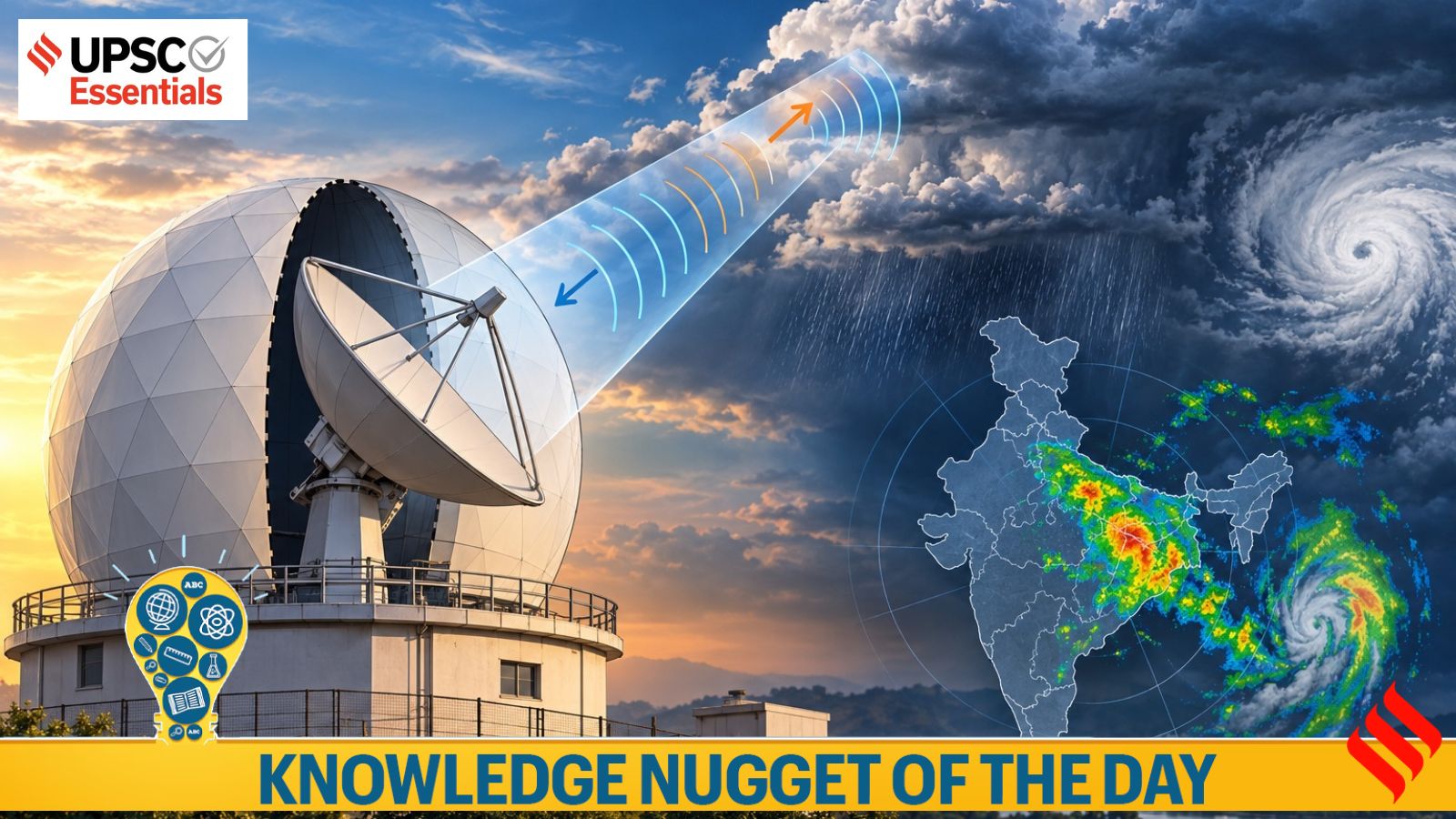
On September 17, Union Minister of State for Earth Sciences Dr. Jitendra Singh virtually inaugurated India's 51st state-of-the-art Doppler Weather Radar (DWR) at Sambalpur, Odisha. This expansion is part of Mission Mausam, a government initiative aimed at strengthening India's capacity to observe, understand, and respond to extreme weather events. The addition of this new facility marks an important milestone in enhancing India's weather observation infrastructure, particularly in Western Odisha and neighboring regions.
Doppler Weather Radars work by emitting a beam of radio waves from an antenna. When these waves strike an object in the atmosphere, such as raindrops, some of the energy is reflected back to the radar. The amount of energy returned depends on the size and distance of the object. By observing the time it takes for the beam to be transmitted and returned, weather forecasting departments can determine the position and movement of raindrops in the atmosphere.
What sets Doppler Weather Radars apart is their ability to track both the position and movement of targets. This is achieved by measuring the shift in phase between the transmitted radio wave pulses and the received echo. As the precipitation moves towards or away from the radar, the phase of the pulses changes, allowing for the calculation of movement and the determination of whether the weather system is coming or going.
In India, Doppler Weather Radars of varying frequencies, such as S-band, C-band, and X-band, are commonly used by the Indian Meteorological Department (IMD). These radars help track weather systems, cloud bands, and gauge rainfall over an extensive coverage area of about 500 km. The radars play a crucial role in guiding meteorologists, especially during extreme weather events like cyclones and associated heavy rainfall.
For instance, an X-band radar is used to detect thunderstorms and lightning, while a C-band radar assists in cyclone tracking, and an S-band radar is the primary choice for deep coastal cyclone monitoring.
The phase shift observed in Doppler Weather Radars is based on the Doppler effect, first discovered by Austrian physicist Christian Doppler in the 19th century. This effect explains why the pitch of a sound wave changes as an object approaches or moves away from an observer. Similarly, as an object moves towards the radar, the phase of the pulses changes, allowing for the measurement of its movement.
Despite transmitting a signal for only over seven seconds in an hour, Doppler Weather Radars spend the remaining time listening to the returned signals, making them a vital tool for accurate weather forecasting.
Written by urgent.news from The Indian Express's reporting — not their text. Machine-written — may contain errors; check the original before relying on it.