Insight Innovation: Europas Abschreckung: Wie gut können Frankreichs Atomwaffen Deutschland schützen?
Erstmals beteiligt sich die Bundeswehr an Frankreichs streng geheimer Nuklearübung. Was Macrons Abschreckung für Europa leisten kann und welche Rolle Deutschland dabei spielen soll.
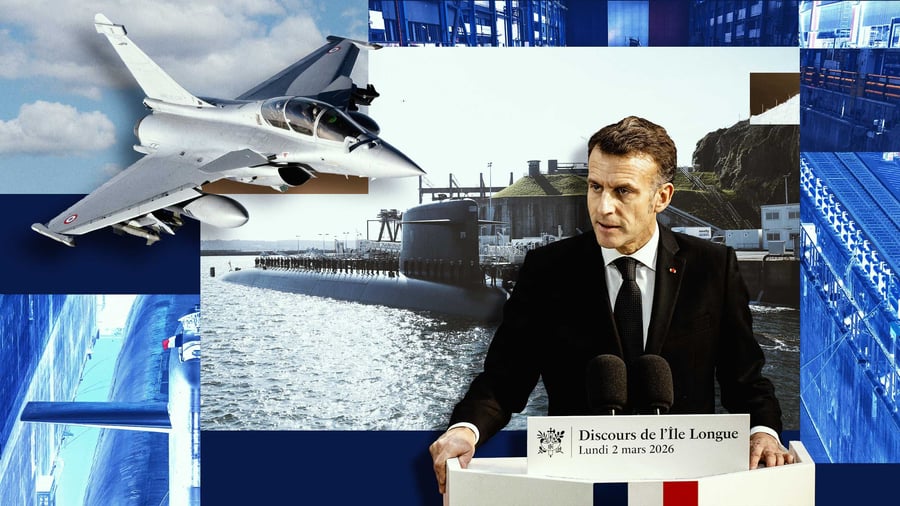
In a secretive operation called "Operation Poker," French military jets perform nuclear drills over France multiple times a year to simulate real-life attacks. This year marks the first time Germany has participated in the exercise. The initiative is led by President Emmanuel Macron, who has proposed opening up French nuclear deterrence more for European partners. He explained that in a dangerous and unstable world, one must be feared to be free.
Germany, being a central power in Europe with substantial conventional military forces, is considered a key state in this arrangement. Nine other countries are involved in the operation, with Finland recently joining the list. While Germany is getting closer to France's nuclear deterrence, a crucial question arises: How far would France's protective promise actually reach in case of an emergency? What if there's a change of power in Paris?
In early December, residents of Bourges, Central France, were rudely awakened by military jets flying overhead. The planes had recently departed from the Avord Air Force Base for the Operation Poker. Four times a year, France trains with over 40 aircraft to carry out a nuclear attack, using Rafale jets, which are not equipped with weapons but carry mock nuclear-capable missiles. These drills involve high-performance jets refueling in mid-air, penetrating enemy air defenses, and simulating the use of atomic weapons.
For France's strategic air forces, Operation Poker is one of the most important missions. The country has 40 nuclear-capable Rafale combat jets, with some kept in constant readiness. France also deploys nuclear-armed Rafale jets from an aircraft carrier, allowing them to operate far from the French mainland. The main element of France's deterrence is its nuclear-armed submarines, with at least one always on patrol.
The French Navy operates four strategic submarines of the SNLE class, named "Le Terrible," "Le Téméraire," and others, each carrying 16 M51 ballistic missiles. Once launched, these missiles follow a ballistic trajectory, meaning they primarily follow the force of gravity. The 12-meter-long and over 50-tonne M51 is a multi-stage, solid-fuelled intercontinental missile capable of carrying multiple nuclear warheads.
France understands its nuclear arsenal as a defensive tool, not for pre-emptive warfare. The French nuclear doctrine is strictly defensive and aims to deter potential adversaries from launching a second strike. The reasoning behind this is that the mere possibility of a nuclear second strike should dissuade any attacker. According to Emmanuelle Maitre from the French Strategic Research Foundation (FRS), submarines are very mobile and difficult to detect, meaning they can still carry out a second strike, regardless of the situation.
The use of atomic weapons in France is decided solely by the President, just like in the United States. While France's nuclear deterrence is worldwide, its M51 missiles have an estimated range of 8,000 to 10,000 kilometers. Upon re-entry into the atmosphere, they reach speeds of around 20,000 kilometers per hour, according to Arianegroup, the missile's manufacturer.
The flight systems are also designed for long distances. The Rafale combat jets can launch cruise missiles at targets over 500 to 600 kilometers away without having to fly directly over them. These cruise missiles are designed to avoid or penetrate enemy air defenses, unlike the United States, which has smaller tactical nuclear weapons for ground-based use.
However, France does not have smaller tactical nuclear weapons for use on the battlefield. This represents a key limitation of France's nuclear umbrella: it is designed for strategic deterrence, not for operational use in the field. Paris does not claim to replace the nuclear protection provided by the United States or NATO. For France, the deterrence serves to complement its own.
The arsenal is smaller than that of the United States with around 3,700 warheads, and Russia with approximately 4,400 warheads. However, France's approach differs fundamentally. French researchers from the FRS explain that France does not aim to destroy an adversary's arsenal. In contrast, the United States and Russia size their arsenals for scenarios where they need to neutralize a large number of enemy nuclear forces and control escalation. From France's perspective, a smaller arsenal is sufficient for the goal of deterrence.
Written by urgent.news from Handelsblatt's reporting — not their text. Machine-written — may contain errors; check the original before relying on it.