Former V-P Ansari remembers ‘one-man institution’ A.G. Noorani
The Noorani Records, a publication of The Hindu Group containing some of the best writings of the late columnist, was released by Mr. Ansari in the presence of former Union Minister Salman Khurshid.
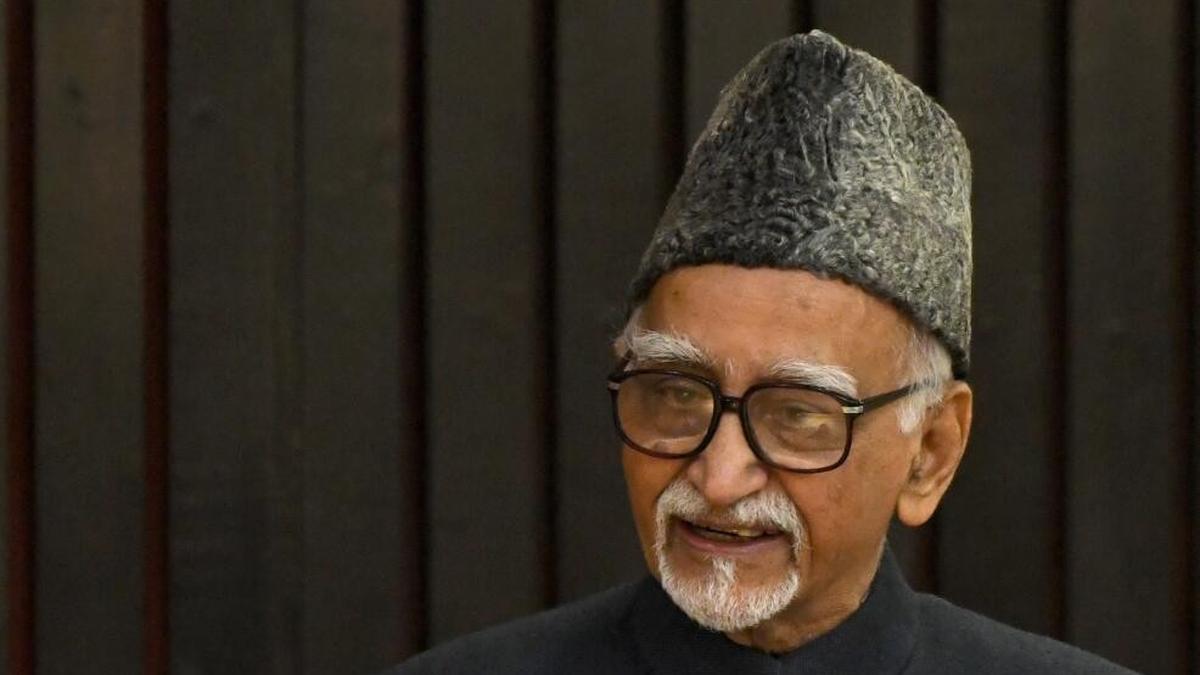
At a memorial lecture held at the India Islamic Cultural Centre in New Delhi on Friday, former Vice-President M. Hamid Ansari remembered the late legal expert and columnist Abdul Ghafoor Noorani as a "polymath" and "one-man institution". Ansari, calling Noorani one of the sharpest minds on constitutional law, highlighted his distinctive approach to work. Although Noorani was not a grassroots reporter, he possessed an innate understanding of the nation's pulse, according to Ansari.
The Noorani Records, a publication of The Hindu Group featuring some of the late columnist's best works, was released by Ansari in the presence of former Union Minister Salman Khurshid. Noorani, who wrote for The Hindu and Frontline for nearly four decades, was known for his unwavering commitment to justice, civil liberties, minority rights, secularism, and constitutional governance.
Ansari praised Noorani's deep understanding of constitutional law, particularly in issues ranging from constitutional amendments and the Anti-Defection Bill to the recent Citizenship (Amendment) Act. He also recognized Noorani's insightful analysis of Kashmir's ups and downs. Born into the Kutchi Memon community in Bombay, Noorani was known for his privacy and reserve, preferring to spend his time reading and writing.
Ansari emphasized that Noorani's writings covered a wide range of topics, including domestic politics, jurisprudence, international relations, and history. He frequently combined legal, political, and historical perspectives in his works. Notably, Noorani's 1963 biography of then President Dr. Zakir Husain received praise from Jayaprakash Narayan for its portrayal of Husain's life as "active, creative, refined, dedicated, fearless, and truthful."
Ansari recalled that Noorani's concern for justice was evident in his 1963 book, The Trial of Bhagat Singh: Politics of Justice, where he argued that Bhagat Singh and his colleague were victims of judicial murder. His scholarship extended beyond Indian constitutional and political matters, as seen in his study of the India-China boundary dispute, which examined its historical origins from 1846 to 1947 through the lenses of history, law, morality, and political expediency.
Written by urgent.news from The Hindu's reporting — not their text. Machine-written — may contain errors; check the original before relying on it.