An 'impossible' black hole merger may finally be solved thanks to Einstein's relativity — but it raises an even bigger mystery
New research suggests that a perplexing signal created by a pair of colliding black holes may have been warped by a space-time phenomenon known as gravitational lensing. This theory could finally explain the "impossible" size of the merging singularities, but it also poses a new problem.
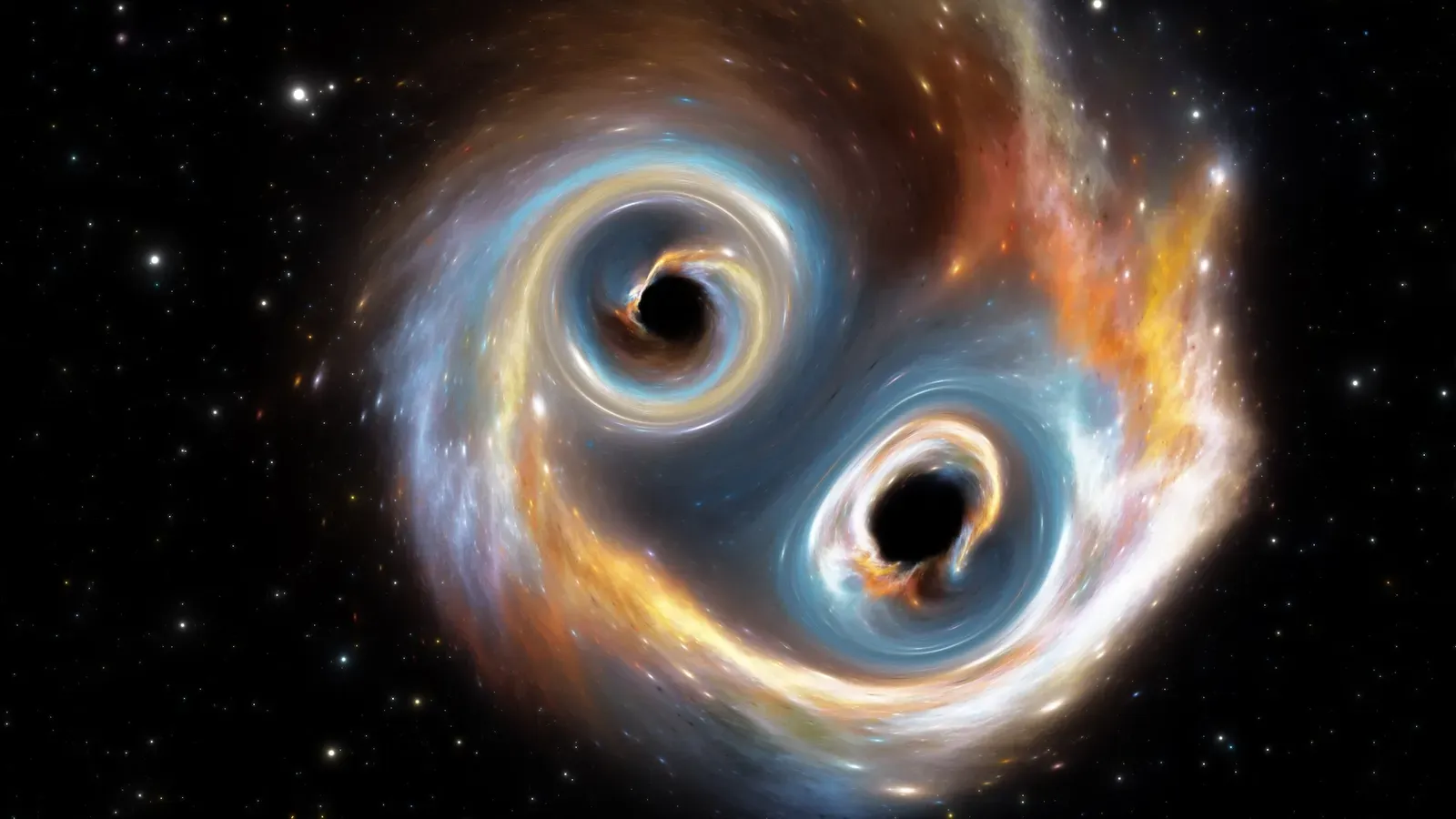
On November 23, 2023, the Laser Interferometer Gravitational-Wave Observatory (LIGO) detected an unusual set of gravitational waves, dubbed GW231123. The signal originated from two black holes colliding 2 billion light-years away, creating a singularity 230 times more massive than the Sun. However, the parent black holes were unusually large, weighing 100 and 130 solar masses, respectively.
This size defies current understanding, placing them in a "mass gap" between stellar-mass and intermediate-mass black holes. Moreover, the colliding black holes were spinning faster than expected. To explain the impossible merger, researchers propose that the signal was warped by gravitational lensing, a phenomenon predicted by Albert Einstein's theory of general relativity.
Gravitational lensing occurs when massive objects warp space-time, distorting the path of light and gravitational waves. In the new study published in The Astrophysical Journal Letters, researchers modeled how gravitational waves might be altered by a lensing object and found that the GW231123 signal could have been magnified, greatly exaggerating the masses of the colliding black holes.
If a compact object of 190 to 850 solar masses or an extended structure like a globular cluster lensed the signal, the total mass of the newly merged black hole would be around 140 solar masses, resolving the mass gap mystery. However, gravitational lensing of gravitational waves has never been observed before, and the new theory remains purely theoretical, lacking direct evidence such as an accompanying Einstein ring.
Written by urgent.news from Live Science's reporting — not their text. Machine-written — may contain errors; check the original before relying on it.