Zufallsfund vor 35 Jahren: Irrweg als Glücksfall: Wie Ötzi zur Weltsensation wurde
Sein Fund war eine Sensation. Ötzi starb vor 5.300 Jahren - heute kann er in einem speziellen Kühlraum besichtigt werden. Forschenden gibt die Mumie noch immer viele Rätsel auf.
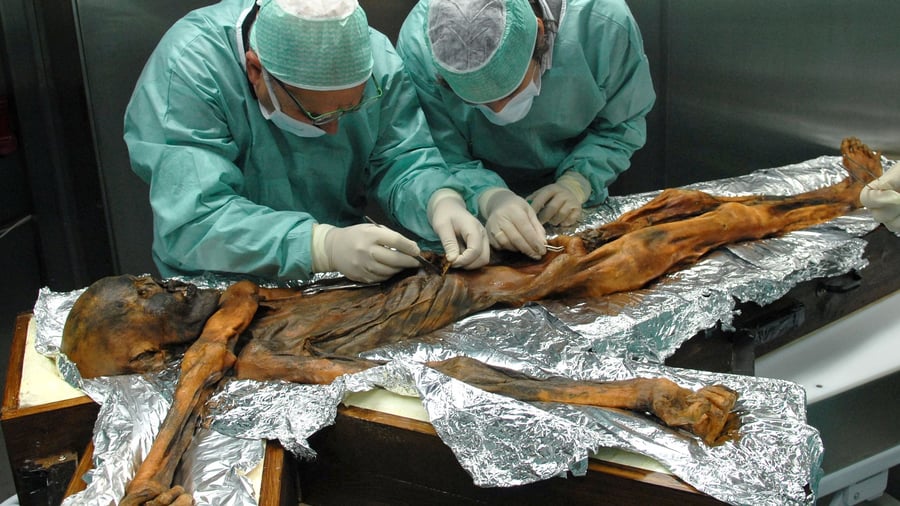
In 1991, a chance discovery in the Ötztaler Alpen revealed a 5,300-year-old mummy, named Ötzi, who became a worldwide sensation. The man was found by Helmut and Erika Simon, a couple who had strayed from their route in the border region between Austria and Italy. The impeccable preservation of Ötzi's remains sparked numerous scientific inquiries.
The Simons were initially shocked by the media attention and had to avoid phone calls. The Albers, who estimated Ötzi's age, had no intention of conducting an autopsy as it was clear there was no perpetrator to investigate.
Ötzi was kept in optimal conditions in Innsbruck for almost seven years, with studies conducted once a month. In 1998, he was transferred under strict security measures from Innsbruck to Bozen, where he has been on display since March in the South Tyrolean Archaeological Museum. The Gletschermann, or glacial man, can now be seen in a glass case under dim light.
The discovery of Ötzi provided valuable insights into the lives of ancient peoples. For instance, the deep wound on his thumb and index finger was likely caused by a defensive movement, occurring two days before his death. He had survived various conditions, including an injury to his shoulder and a poisoned arrow to the shoulder, as evidenced by the lack of readiness of his bow and only two of his arrows being poisoned.
The unique preservation of Ötzi's body has been attributed to its location in a meter-high snow layer and then sliding down a large rock, while the cold conditions in the alpine region allowed the tissue to become waxy. The glacial conditions kept Ötzi frozen for over 3,800 years, and it remained in an icy capsule for the following 5,300 years.
Ötzi's exceptional condition and the wealth of information he provided made him a priceless find for researchers. His diet, health, and possessions offer a unique glimpse into the life of a high-altitude farmer in the Early Bronze Age. Recent studies have also found traces of four cold-loving bacteria in his stomach, suggesting that Ötzi is not merely a static relic but rather a living window into the past. The hope is that future analyses will continue to shed light on both Ötzi and the era in which he lived.
Written by urgent.news from Handelsblatt's reporting — not their text. Machine-written — may contain errors; check the original before relying on it.