Scientists move to develop local climate-smart system to monitor rainfall patterns, crop water use
A research collaboration involving scientists from Ghana and international institutions is building and installing open source geophysical technology to help farmers and policymakers better appreciate how water moves through agricultural soils and ways farming practices can be adapted to a changing climate.
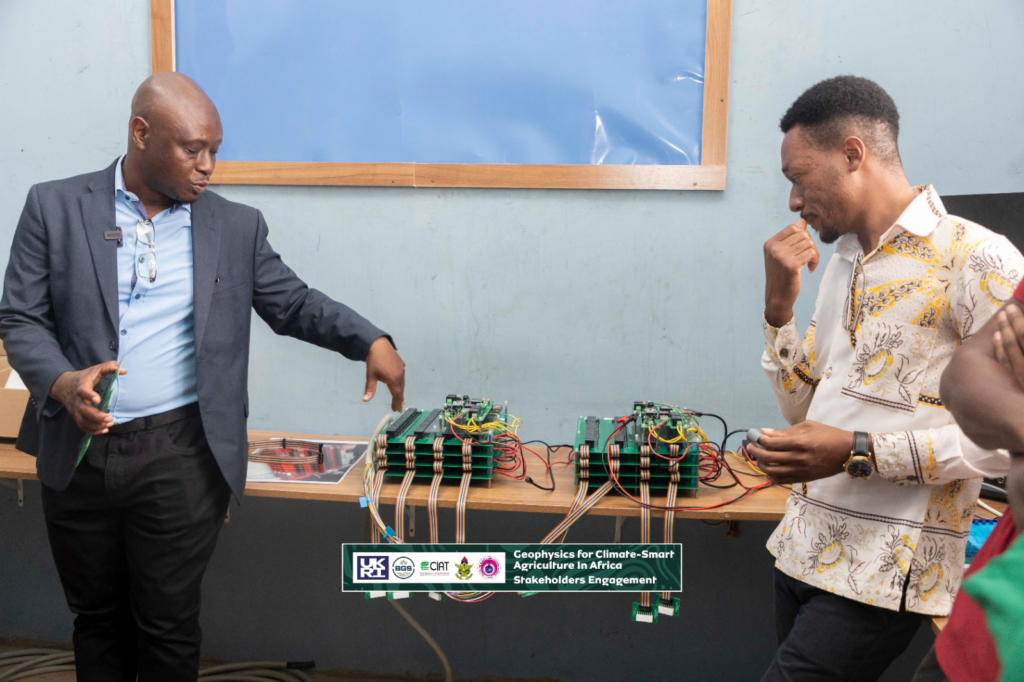
A research collaboration between scientists from Ghana and international institutions is developing open source geophysical technology to monitor rainfall patterns and crop water use, aiming to assist farmers and policymakers in adapting to a changing climate. Known as the Geophysics for Climate-Smart Agriculture in Africa Project, the two-year initiative unites expertise in geophysics, soil science, and agronomy to explore the connections among soil-water dynamics, farming practices, crop productivity, and climate resilience.
At the heart of the project is the creation of low-cost Electrical Resistivity Tomography (ERT) monitoring systems at the Kwame Nkrumah University of Science and Technology (KNUST), spearheaded by the West Africa Geophysics (WAGeo) Lab. These ERT systems will enable researchers to track changes in rainfall, crop water use, and various agricultural management practices, providing valuable insights into how factors like cover cropping, tillage variations, and residue management impact soil-water conditions and crop performance.
The project team, including Dr. Cyril D. Boateng of the West Africa Geophysics Laboratory, aims to cultivate local expertise in geophysical instrumentation, monitoring, and data processing. By developing local systems, the project seeks to empower early-career researchers and facilitate knowledge transfer across generations of researchers in Ghana and the wider West African region.
Dr. Michael Kweku Edem Donkor, who leads the instrumentation component, emphasizes the importance of reliable instrumentation and the critical role of local capacity building in partnership with the British Geological Survey (BGS). Russell Swift of BGS highlights that the collaboration is helping KNUST transition from occasional measurements to continuous ERT monitoring, providing early-career researchers with hands-on experience in geophysics, soil physics, experimental design, instrument development, data processing, and data management.
Addressing a persistent challenge in African geophysical research—the high cost of importing specialized instruments and the difficulty of maintenance—this project in Ghana seeks to create a self-sustaining team capable of maintaining and adapting the equipment to future research needs. Dr. Steven Yeboah, a Principal Research Scientist at the CSIR-Crops Research Institute and an International project co-lead, underscores the value of combining geophysics with crop research to gain new insights into agricultural practices.
The project involves the International Center for Tropical Agriculture (CIAT), which emphasizes the importance of interdisciplinary collaboration in tackling complex agricultural challenges. By combining insights from beneath the soil with agricultural management and crop performance, the collaboration aims to support more resource-efficient and climate-resilient farming systems.
Beyond the two-year project, researchers aspire to demonstrate the feasibility of advanced geophysical monitoring through locally-built open source technology, bolstering African scientific capacity and applying the data to real agricultural decision-making. As the project advances, researchers will continue refining the ERT systems, collecting field data, and collaborating with agricultural stakeholders to translate findings into practical approaches for managing soil and water under increasing climate pressures.
The project, supported by UK Research and Innovation (UKRI), involves KNUST, CSIR-CRI, the British Geological Survey, the University of Nottingham, and CIAT, with input from stakeholders across agriculture, policy, research, extension services, civil society, water resources, farmer organizations, and the private sector.
Written by urgent.news from MyJoyOnline Ghana's reporting — not their text. Machine-written — may contain errors; check the original before relying on it.