Lessons from failure: the ANC's electoral court setback and the need for organisational introspection
As the ANC stands at this critical juncture, the poignant questions of organisational failure have surfaced. In a landscape marked by shifting political dynamics, can the ANC transform its rich legacy into a contemporary framework of professional competence and operational discipline? The path ahead will require courage, honesty, and an unwavering commitment to the ideals that have defined the…
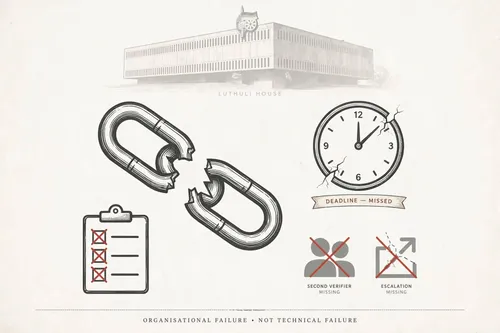
The African National Congress (ANC), a political force closely intertwined with South African history, recently experienced a setback in its electoral process. Their challenge over 181 candidates excluded from the upcoming local government elections did not prevail in the Electoral Court. The court dismissed the ANC's appeal, dismissing the technical difficulties claim provided by the ANC and attributing the failure to the final electronic submission not being completed by the deadline.
The ANC is now contemplating further legal actions. However, beyond the courtroom, the ANC should introspect and question its organizational capability. The question is not about incompetence, but rather about the development of systems, disciplines, and internal controls necessary to translate political intention into effective execution.
Organisational failures usually do not stem from a single mistake. They often occur due to intersecting weaknesses such as unclear responsibility, inadequate communication, weak controls, insufficient oversight, or a culture that discourages early reporting of issues. While candidate nominations might seem like a political exercise, they are in fact a highly regulated administrative process where deadlines, documentation, verification, information systems, accountability, and time management are critical.
The distinction between information being captured on a system and a formal submission being completed may appear technical, but it is decisive. Even though the ANC registered 8,947 candidates, with 181 affected across six municipalities, the failure was not widespread. However, this does not diminish the importance of the issue.
Mature institutions do not merely focus on the number of successful submissions; they also emphasize the strength of their controls to prevent failures at critical points. A buffer is necessary to identify and resolve problems before they become irreversible. The issue is not solely about technical problems or identifying responsibility but rather why the organization's processes did not safeguard against a failure occurring so close to a non-negotiable deadline.
The ANC might argue that this is a struggle of an old liberation movement adapting to modern technology. However, this is a simplistic explanation. Despite operating for decades without many of the institutional advantages of a conventional political organization, the ANC had to rely on discipline, adaptability, and the ability to operate under difficult conditions.
The more pertinent question is whether these strengths have been successfully translated into the capabilities required of a modern political institution. This transformation is not primarily about technology but about organizational culture. Effective organizations require clear lines of responsibility, competent administration, reliable information, effective escalation mechanisms, and accountability when systems fail.
Political loyalty and organizational competence are not synonymous. A person can be deeply committed to an organization and still lack the technical or administrative competence for a specific responsibility. Moreover, questioning organizational issues should not be perceived as disloyalty. Institutions become stronger when they foster an environment where individuals feel confident to identify risks and challenge assumptions before minor problems escalate into institutional failures.
The Electoral Court's decision also underscores another principle: political weight does not compensate for weak administration. The ANC's historical legitimacy is undeniable, but constitutional institutions operate under rules applicable to all political organizations, irrespective of their history or size. This principle is crucial in safeguarding the electoral process and ensuring that all political parties are held to the same standards.
When organizations face failure, it is natural to first focus on external circumstances. However, resilient institutions also ask a more challenging question: what was within our control, and what should we have done differently?
Written by urgent.news from IOL's reporting — not their text. Machine-written — may contain errors; check the original before relying on it.