Kohlendioxid-Lagerung: CO2-Lager im Meeresgrund: Dänemark feiert Regelbetrieb
Schon seit mehreren Jahren wird in Dänemark die Lagerung von CO2 im Meeresgrund getestet. Jetzt geht das Projekt „Greensand“ laut der Verantwortlichen in den Regelbetrieb. Am Ziel ist es noch nicht.
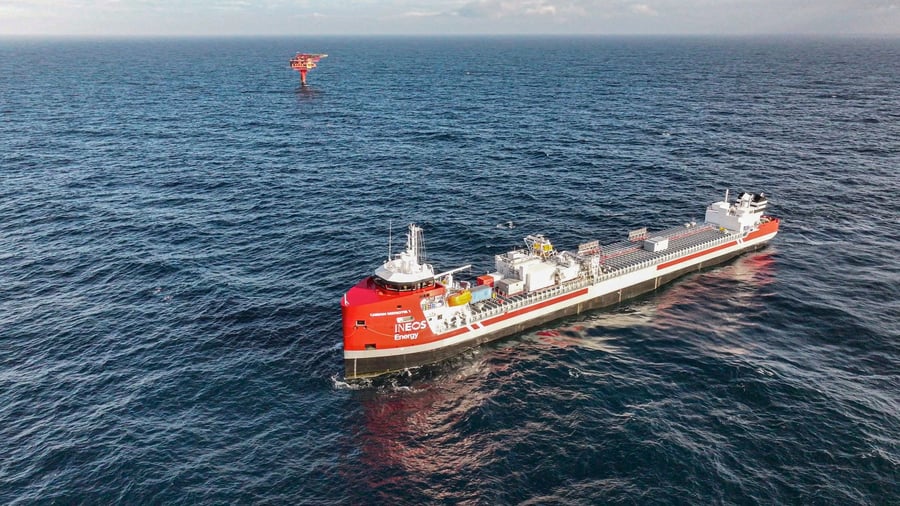
Denmark officially inaugurated a subsea CO2 storage site in Esbjerg on Friday morning, marking the commencement of commercial CO2 storage in the North Sea. Since 2023, the pilot project "Greensand" has been testing CO2 injection at the decommissioned Nini West oil field, annually depositing around 15,000 tonnes of liquefied CO2 at a depth of 1,800 meters.
If operational, the site aims to store up to 400,000 tonnes of CO2 per year. The technology, known as Carbon Capture and Storage (CCS), works by capturing CO2 from industrial processes and storing it in underground reservoirs. While experts consider the method safe, environmentalists worry it may encourage further emissions by providing an easy escape route for harmful greenhouse gases instead of aggressively reducing emissions at the source.
Denmark's Greensand site is the first in the EU to store CO2 on an industrial scale, with commercial CO2 storage facilities already existing off the coast of Norway. The project is a collaboration between the British chemical company Ineos, Harbour Energy, and the Danish state company Nordsøfonden. Danish professor of sustainable energy planning, Brian Vad Mathiesen, from the University of Aalborg, noted that "400 million tonnes may seem like a lot, but in a European context, it is utterly insignificant."
He emphasized that if we aim to become climate-neutral, we need to find ways to store CO2 in one way or another, as some emissions are unavoidable, particularly in the cement industry. The challenge, however, is often the cost, as Mathiesen pointed out, with the technology currently being too expensive for many industries to adopt and reduce their carbon footprint.
Initially, the CO2 will primarily come from Danish biogas plants, but the consortium hopes to attract large German industrial facilities in the future. For this to happen, better policy frameworks need to be established, according to the responsible parties. Germany's coalition government freed the way for undersea CO2 storage last year, aiming for climate neutrality by 2045, meaning not emitting more greenhouse gases than can be stored.
Federal Chancellor Friedrich Merz sees CCS technology as a chance for German industries to become economically competitive while reducing emissions.
Written by urgent.news from Handelsblatt's reporting — not their text. Machine-written — may contain errors; check the original before relying on it.