Interview: Revolut-Chef: „Wir wollen die Nummer eins in Deutschland werden – so schnell wie möglich“
14 Millionen Briten und acht Millionen Franzosen sind Kunden bei Revolut. In Deutschland ist die Digitalbank noch klein. Nik Storonsky will das ändern – im Interview erklärt er seine Strategie.
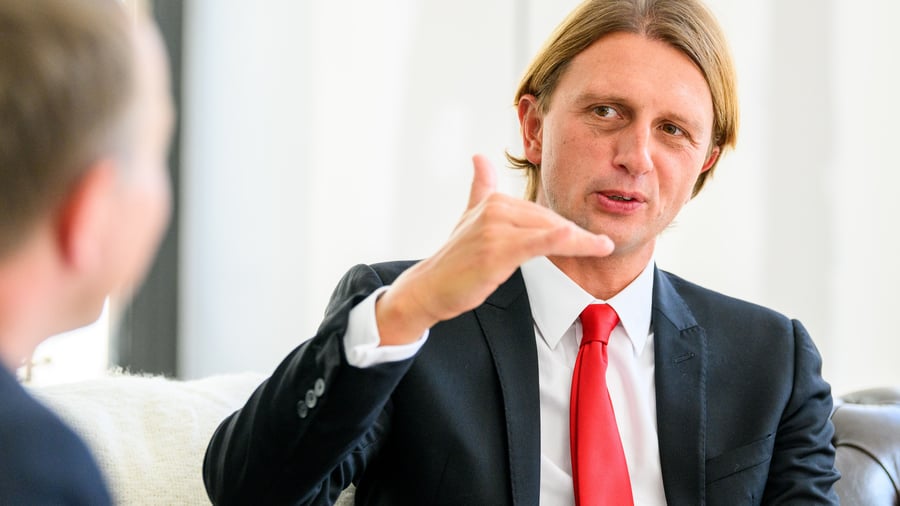
Nik Storonsky, the CEO of Revolut, greets the Handelsblatt reporter at a construction site. The scene is chaotic, with ducts and cables hanging from the ceiling, and a scaffolding set up in the hallway. The floor is covered with protective plates. The new European West headquarters of the British digital bank is far from complete, with completion expected in 2027.
The office sits between the stock exchange district, the historic center of France's financial hub, and the Sentier district, home to many tech firms and startups. This location is a statement and a sign of Revolut's global expansion ambitions.
Storonsky sits in a second-floor room dressed in black with a red tie, on a couch. His first impression is of his firm handshake, soft voice, and almost shy demeanor. However, in conversation, it becomes clear that confidence is not a concern for the 42-year-old. In Germany, Storonsky has big plans. The interview was conducted prior to the revelation of a data leak affecting 680 customers. Read about it here. You can find the interview with Nik Storonsky here.
Storonsky, Revolut started in 2015 as an app for paying while traveling. Today, the bank has 80 million customers and is the most valuable European FinTech. What is your secret to success? Success is similar to the goal of humanity to build a city on Mars. It doesn't happen overnight, but it requires many small steps. Revolut has introduced new products over the years, obtained more licenses, and entered more markets.
It hasn't had one big breakthrough. Revolut started in the UK, where there are now 14 million customers, followed by France with eight million and Spain with six million customers. In Germany, where you are still relatively small with just over three million customers, why is that? In Germany, the use of cash is much higher compared to other western European markets.
People rely less on digital banks. Additionally, German customers value German IBANs, which we could only offer starting in early 2024 after opening a German branch. How do you plan to catch up in Germany? We have been working for years to better tailor our offer to the German market. We have also simplified the account opening process.
Initially, customers had to undergo video identification with a Revolut employee, which was not fully digital and could take up to seven hours. This was not a great user experience. Now, we have accelerated the process. Revolut has recently launched a campaign offering 4.25% on term deposits for four months to attract German customers.
Is this the beginning of a major offensive in Germany? Yes, we are currently relatively small in the German market and want to change that in the coming years. Therefore, we are offering new savings and investment products. We are also investing heavily in marketing, both digital campaigns and classic advertising. Since this year, we have sponsored the Audi Formula 1 team.
Our goal is to be a market leader in each of the ten European core markets by 2028. In Germany, we are currently lagging behind savings banks, which have around 38 million private current accounts. Do you consider it realistic to become the market leader in Germany? We want to be the market leader in Germany - as soon as possible.
We have been weaker in Germany than some competitors. In this quarter, our app downloads have placed us at the top for the first time, ahead of the savings banks. Our growth in Germany is just beginning to take off. Perspectively, Germany is supposed to be our largest market in Europe. That you have been weaker in the past than in other countries, analysts also attribute to the fact that Revolut has only been regulated by the Lithuanian Central Bank and the European Central Bank (ECB) since 2019.
This oversight was not apparent to many, including in the press. Since Revolut has been classified as systemically important, we have been regulated by the ECB since 2019, a top regulator. Consequently, it should not matter where the regulated bank is based. For many people, it apparently did matter, especially in Germany. Would you have tried to obtain a license in a major EU country earlier if you had known?
With the knowledge we have now, perhaps. But you must remember that we only had 100 employees in 2019 with limited capital, management capabilities, and little access to experienced bankers. At that time, it made sense to go to Lithuania because we could achieve the same result with fewer resources. Analysts point out that customers in the UK have less money in Revolut compared to major UK banks because they don't trust Revolut as much.
Even in Germany, Revolut is not the main bank for the majority of its customers. Is a lack of trust still a problem for Revolut? In many countries, we are the main bank for about 20% of our active users. This is less than established banks that have existed for over 150 years and have built up a lot of trust. We are a newcomer. But it's just a matter of time until our customers trust us as much.
Written by urgent.news from Handelsblatt's reporting — not their text. Machine-written — may contain errors; check the original before relying on it.