Daimler Truck brings NextGenH2 to IAA as hydrogen pact forms
Europe has 187 hydrogen stations, most at the wrong pressure for long-haul trucks. Eight companies used IAA Transportation to say what it will take to fix that. The post Daimler Truck brings NextGenH2 to IAA as hydrogen pact forms appeared first on FreightWaves .
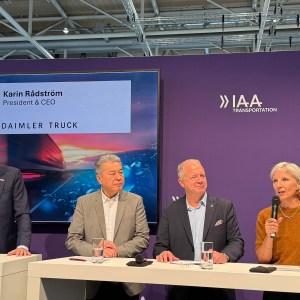
Two of Europe's largest truck manufacturers, Daimler Truck and Volvo Group, joined forces at the IAA Transportation in Hanover, Germany, to address the shortcomings of battery-electric vehicles, which they say were outpaced by the lack of charging infrastructure. The duo, along with eight other companies, announced a joint effort to bring hydrogen trucking to Europe by 2030, starting with Germany as a model.
Daimler Truck unveiled its Mercedes-Benz NextGenH2 Truck at the event, with plans to introduce 100 units to customers by the end of 2026, with the first batch of 50 already sold. The company expects to invest a mid-three-digit million euro sum in hydrogen trucks by the end of the decade. The NextGenH2 is capable of covering over 1,000 kilometers on a single fill of liquid hydrogen, and it carries 1.3 metric tons more payload than Daimler's battery-electric eActros 600 due to the absence of batteries.
The trio explained that Europe's vast fleet of 6.2 million trucks consumes about 60 million metric tons of diesel annually, equivalent to 500 terawatt-hours of electricity, nearly matching Germany's total annual electricity production. The trio stressed that hydrogen pricing is crucial to the business case, targeting €6 per kilogram.
Both truck makers aimed for the same price point, stating that reaching it would make the venture economically viable. European hydrogen stations currently operate at 350 bar pressure, which does not provide the extended range needed for long-haul trucking. Air Liquide is actively building the supply side of the equation, with electrolyzer installations in Oberhausen, Normandy, and Rotterdam.
Heavy-duty trucking must simultaneously tackle three challenges: establishing a reliable station network, securing affordable fuel, and synchronizing efforts between truck manufacturers and infrastructure operators. Ultimately, Air Liquide's Armelle Levieux emphasized that liquid hydrogen is the most promising solution for achieving diesel parity and driving up volumes and scale.
Written by urgent.news from FreightWaves's reporting — not their text. Machine-written — may contain errors; check the original before relying on it.