Could China’s sixth-generation fighter carry a laser to defend against incoming missiles?
China may be aiming to equip its sixth-generation fighter jets with laser weapons that experts say could help defend them against incoming missiles. At the 14th China International Defence Electronics Exhibition, held in Beijing from September 15 to 17, the Aviation Industry Corporation of China (AVIC) Beijing Precision Engineering Institute for Aircraft Industry presented details of a “fighter…
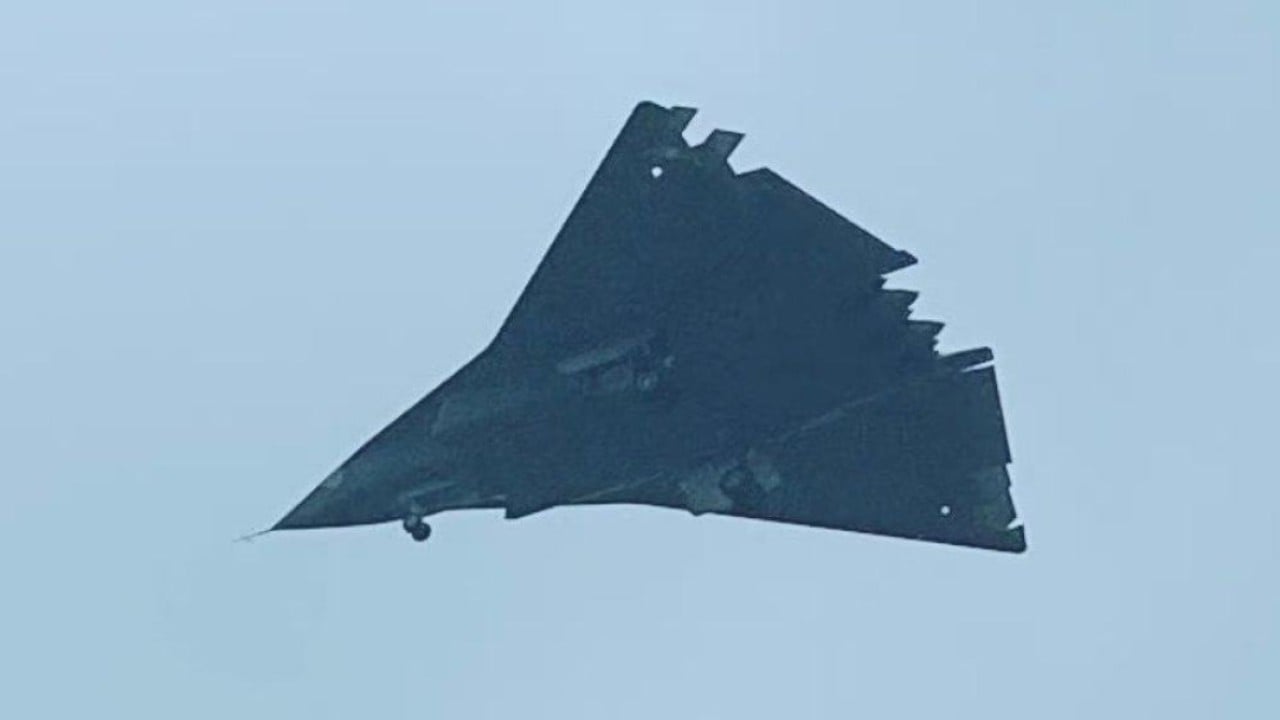
China's Aviation Industry Corporation of China (AVIC) showcased a "fighter aircraft laser-weapon tracking and aiming system" at the 14th China International Defence Electronics Exhibition in Beijing from September 15 to 17. According to promotional materials, the system weighed less than 380kg (838lbs) and was designed to track and aim laser weapons on board a sixth-generation fighter jet.
The transmission power of the system was listed as "100kW" and its dynamic tracking accuracy as "μrad (RMS)", both values indicating high performance. The system's display paired it with an image of a large tailless aircraft, identified by researcher Andreas Rupprecht as the J-36, an unofficial name for a third-engine jet believed to be a sixth-generation fighter under development by Chengdu Aircraft Corporation, a state-owned AVIC subsidiary.
Experts believe the J-36 has sufficient space, weight, and power to accommodate a high-energy laser system. Lasers are considered easier to implement on larger aircraft than smaller ones due to the availability of space, weight, and power. While no public evidence exists of such a system being fitted and flight-tested on a Chinese fighter aircraft, the emergence of Chinese systems capable of countering long-range air-to-air missiles could be significant.
China has previously sought suppliers for an "airborne laser attack pod" and control software for a "laser attack platform". However, the technology still faces challenges such as limited range for destroying physical targets and difficulties in maintaining accuracy during aircraft movement and vibration. The US Air Force's Self-protect High Energy Laser Demonstrator encountered similar issues, with programme manager Jeff Heggemeier citing wind speeds, turbulence, and rapid aircraft manoeuvres as "hard problems".
Despite these challenges, China's interest in airborne lasers, including previous developments like a prototype airborne laser and a study simulating an airborne laser's performance on a transport aircraft, suggests ongoing research and development in this area.
Written by urgent.news from South China Morning Post's reporting — not their text. Machine-written — may contain errors; check the original before relying on it.
This story
This is one outlet's version. Read the fullest account.