Chinese paint cuts wall temperature by 25 degrees Celsius in summer test: report
China has begun mass production of a super-coating that can cut wall temperatures by 25 degrees Celsius in summer, according to the state-run Science and Technology Daily. The material, which has undergone six months of real-world testing at a petrochemical plant in the southern island province of Hainan, uses the principles of radiative cooling. It requires neither electricity nor cooling agents…
China has officially begun large-scale production of a novel super-coating that can reduce wall temperatures by 25 degrees Celsius during the summer months, according to a report from the state-run Science and Technology Daily. The innovative material, which has undergone rigorous real-world testing for six months at a petrochemical plant in Hainan province, employs the principles of radiative cooling.
Notably, the coating does not require electricity or cooling agents, and it apparently outperforms other global competitors, as indicated in the report published on September 7. This groundbreaking technology could potentially be utilized in various public infrastructure and residential applications.
The urgency to mitigate heat's impact on buildings was evident across Europe this summer, where sweltering temperatures in air-conditionless homes left many residents uncomfortable. The coating has already moved from a laboratory concept to mass production. After numerous trial runs, the research team established manufacturing standards, ranging from raw material processing to final product testing, leading to an annual production capacity of 600,000 tonnes.
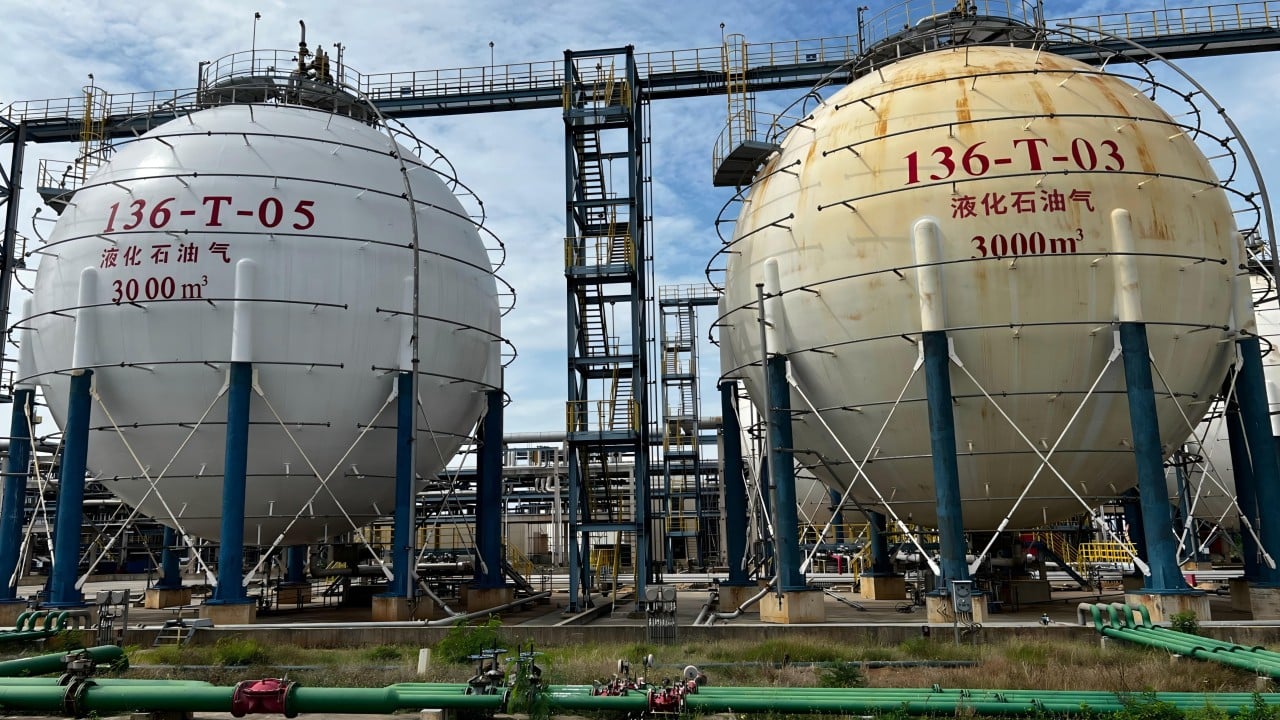
At a petrochemical refinery in Hainan, towering liquefied gas tanks, measuring 3,000 cubic meters (106,000 cubic feet) in total, regularly suffered scorching temperatures that would have posed significant safety risks without immediate cooling. Previously, the facility relied on water-intensive sprinkler systems. However, the super-coating now enables these tanks to cool themselves effortlessly, generating zero energy consumption in the process.
The coated material combines high solar reflectance and strong thermal emittance, reflecting most solar radiation and releasing the accumulated heat outward as infrared energy, all without any power or refrigerants.
Developed jointly by China Construction Eco-Development Company, a state-owned enterprise based in Suzhou, and Harbin Institute of Technology (HIT) in Heilongjiang province, the pioneering coating was created through the collaboration of the two entities. According to a R&D director from the Suzhou-based venture, a treated tank's surface temperature can drop by approximately 25 degrees on a clear day with a temperature of 30 degrees Celsius (86 Fahrenheit), resulting in a decrease of about 7 degrees in internal temperatures.
Traditional sprinklers would be required to achieve a similar cooling effect, consuming an estimated 35 tonnes of water daily per tank, based on some estimates.
Li Xiang, head of the R&D centre at China Construction Eco-Development, highlighted that even during extreme heatwaves, the cooling coating maintains the tank's interior at a safe temperature. This remarkable outcome is attributed to the material's unique infrared emission window. Scientists have long understood that within the atmospheric infrared band of 8 to 13 micrometres, heat can penetrate the Earth's atmosphere and dissipate directly into the freezing vacuum of space.
However, thick applications are needed for traditional radiative cooling materials to be highly reflective and emissive. This bulkiness results in several drawbacks, including increased costs and impaired heat dissipation efficiency. To overcome this limitation, the research team drew inspiration from the microscopic structure of human skin wrinkles, incorporating various functional fillers in a collaborative manner to achieve both high reflection and emission within a much thinner layer.
Consequently, the coating's thickness is reduced from 500 micrometres to 100 micrometres – thinner than a standard sheet of A4 paper – while improving both solar reflectance and infrared emissivity to 97 percent.
Furthermore, the coating demonstrates exceptional durability. During its 180-day on-site trial in Hainan, it withstood 40,000 scrub tests without any signs of blistering or peeling of the paint film. Based on this aging rate, developers expect the coating's effective lifespan to reach up to 15 years. This project exemplifies the journey from scientific research to industrial application, showcasing how groundbreaking discoveries can seamlessly transition into real-world solutions.
Wang Fuqiang of HIT was the original researcher who developed the foundational coating during his academic pursuits. However, after publishing his findings, the project was largely abandoned until Wang's connection with the state construction corporation reignited interest in the advanced cooling solution. Together, the two parties embarked on a journey towards commercialization, starting from laboratory samples and undergoing extensive testing, optimization, and validation.
Ultimately, they successfully established a manufacturing process capable of stable, large-scale production without sacrificing the material's optical performance.
Written by urgent.news from Reuters Business via SCMP's reporting — not their text. Machine-written — may contain errors; check the original before relying on it.
This story
This is one outlet's version. Read the fullest account.