Building Enterprise Context Pipelines: Retrieval, Orchestration, and Cloud-Native Architecture
Build enterprise context pipelines for AI - retrieval, ranking, filtering, compression, access control and prompt assembly with AWS examples.
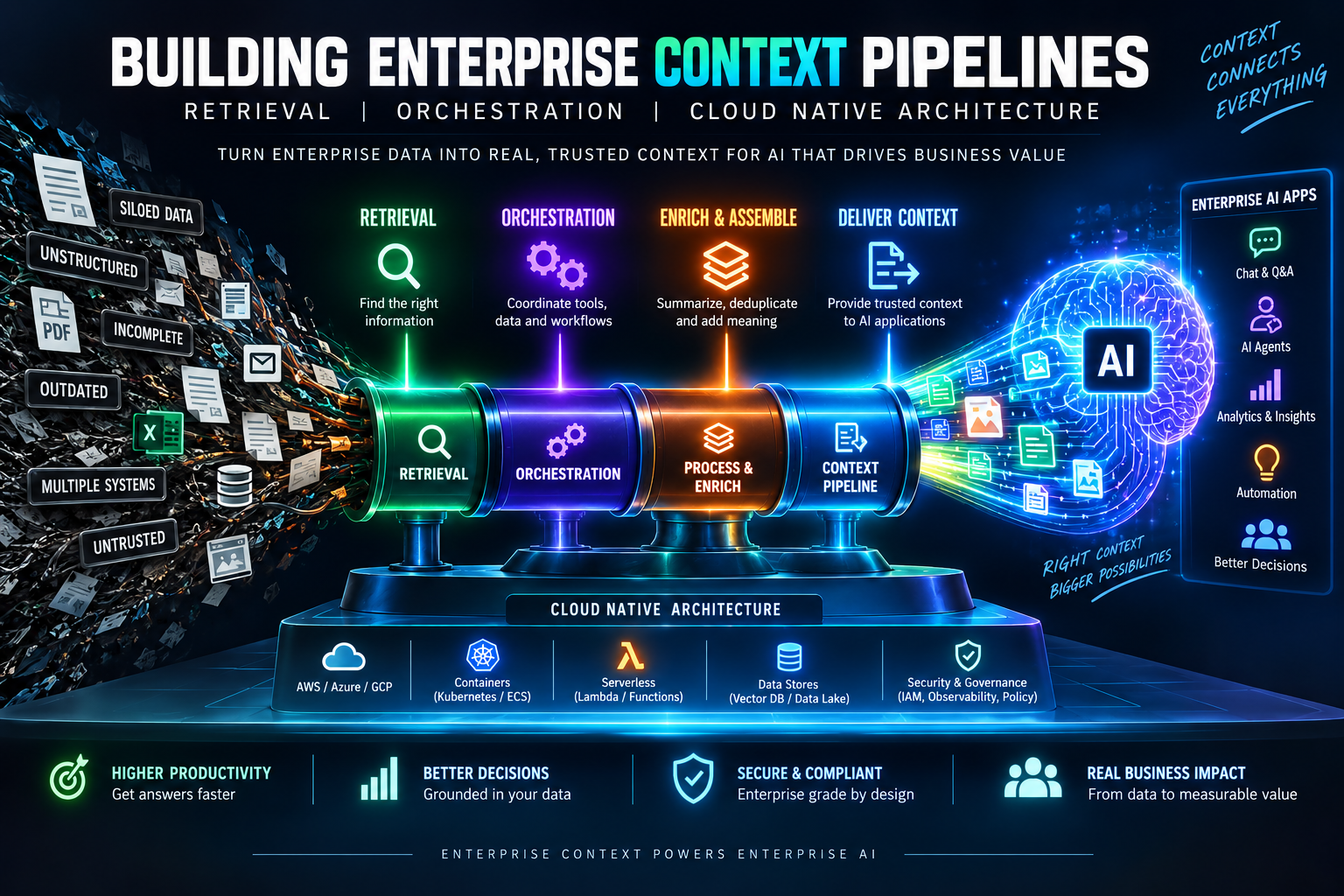
Context pipelines are essential for providing enterprise AI systems with reliable, relevant information. These pipelines take raw data from various sources and transform it into a format suitable for the model, while adhering to important quality dimensions like relevance, freshness, completeness, trustworthiness, and authorization.
An enterprise context pipeline must be able to handle data from a range of sources, including structured databases, documents, APIs, application logs, user interactions, knowledge repositories, and IoT streams. Each source requires a specific retrieval strategy, such as direct querying for structured data, chunking and indexing for documents, real-time API calls, and continuous event stream monitoring.
The context assembly pipeline then processes the retrieved information through several stages. Retrieval locates and gathers candidate information from enterprise data sources, ranking scores these candidates to prioritize the most relevant content, filtering removes irrelevant or outdated information, deduplication collapses repeated or near-identical content, summarization condenses long passages, compression trims the context to fit within the model's context window limits, and access control enforces user authorization.
Managing the context window is crucial, as oversampling can increase processing costs, slow responses, and reduce accuracy. Techniques like chunking, summarization, compression, and token prioritization help manage the context window effectively.
AWS offers a suite of cloud-native services that can simplify the creation of enterprise context pipelines, including S3 for storage, Aurora and DynamoDB for structured data, OpenSearch Service for semantic search, and Lambda for on-demand data fetching. By orchestrating these steps through AWS Step Functions and coordinating with IAM for access control, AI systems can maintain observability and testability at each stage of the pipeline.
Written by urgent.news from HackerNoon's reporting — not their text. Machine-written — may contain errors; check the original before relying on it.