Arbeitsmarkt: Weniger Arbeitslosengeld für Ältere könnte mehr als zwei Milliarden Euro sparen
Ältere erhalten bis zu zwei Jahre lang Arbeitslosengeld – Jüngere nur ein Jahr. Eine Angleichung würde jährlich mindestens 2,4 Milliarden Euro bringen, sagen Arbeitsmarktforscher.
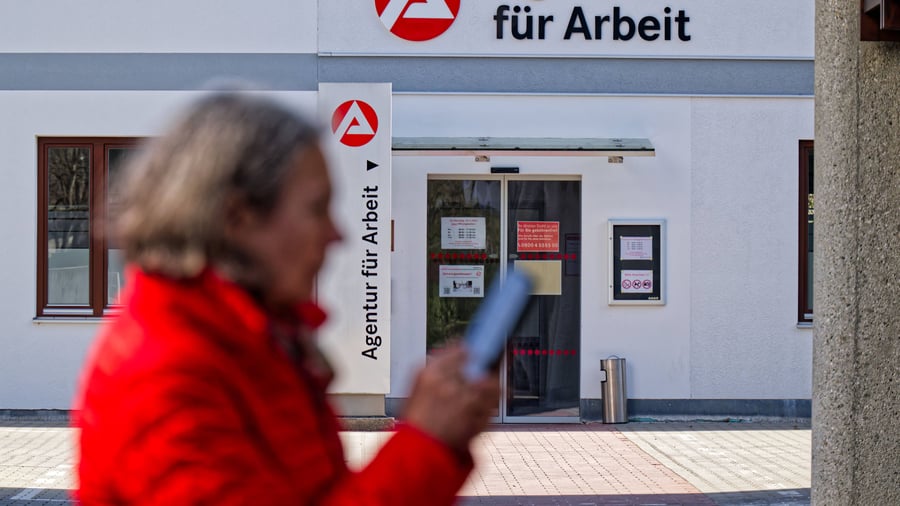
Extending the duration of unemployment benefits for older workers to one year and aligning it with younger workers' limits could save at least 2.4 billion Euros annually, according to a new calculation by the Institute for Labor Market and Occupational Research (IAB). This would also boost the incentive for older workers to quickly find a new job or accept offers.
Currently, the benefit duration varies: unemployed people under 49 receive up to 12 months, those aged 50-54 up to 15 months, and those 55-57 up to 18 months. Above 58, the maximum duration increases to 24 months, provided they worked at least four years in the five years prior. Shortening the maximum benefit period for all older workers to 18 months could still save 1.4 billion Euros per year, the IAB experts calculated based on unemployed people in 2021/22.
Considering today's unemployment benefit values, the total savings would likely exceed 20 percent. This proposal is likely to reignite discussions about unemployment benefits. Employers and economists have long called for shorter benefit durations. The CDU's Economic Council, in particular, has demanded this. The reason is both the labor shortage and the recent sharp increase in the Federal Agency for Labor's deficit.
For this year, the agency predicts a financial gap of 10 billion Euros, which it currently covers with loans. However, given the tight fiscal situation, the federal Employment Ministry does not rule out raising contributions to the unemployment insurance fund in the coming year or as early as 2027, which would burden both employers and employees.
Even savings of around 2.5 billion Euros would "far from be enough to balance the financial deficit in unemployment insurance in the current economic situation," says IAB Director Bernd Fitzenberger. Simultaneously, additional expenditures would arise elsewhere: since older people's chances on the labor market are significantly lower than those of younger people, some of those whose benefits would end earlier would fall into the basic income and require corresponding expenditures.
Additionally, unemployment benefit payments would disappear from the pension fund. The length of unemployment benefit periods increases with age; in the most recent period, half of those over 58 received benefits for only 13 months, compared to just four months for those aged 16-49. However, whenever an age limit is reached after which longer unemployment benefits are paid, the benefit duration jumps.
Experts assume that such jumps would disappear if the duration for all were equal, as data from various groups of unemployed people show. Generally, the benefit duration increases continuously with age. In the oldest group (above 58), half of the unemployed received benefits for only 13 months, while those aged 16-49 received benefits for only four months.
Notably, whenever an age limit is crossed, the benefit duration increases sharply. These "jumps" would vanish if all benefit periods were the same length, experts predict. This behavioral change would typically result in an additional savings of about 50 percent, assuming suitable job opportunities exist. Overall, potential savings could reach over four billion Euros, when 2021/22 data are adjusted to current values and the effects of higher incentives are included.
However, it should be noted that fewer jobs are offered to older workers, and unemployment benefits are also used as a bridge to retirement, as shown by mass layoffs in industry. Politically, there is a "justice question" about reducing the unemployment benefit duration in difficult economic times. According to IAB researcher Simon Trenkle, there are "good reasons" to keep longer maximum benefit periods during downturns.
Public opinion, according to IAB surveys, favors longer benefit periods for those who have paid contributions for a long time, reinforcing the argument for contribution justice. Currently, Federal Minister of Health Carsten Linnemann has also advocated for increasing payments for long-term contributors to maintain contribution justice.
More: Could Social Contributions Exceed 50%? Employer Association Calls for "Massive Savings" First Publication: 15.09.2026, 16:57 (UTC).
Written by urgent.news from Handelsblatt's reporting — not their text. Machine-written — may contain errors; check the original before relying on it.
This story
This is one outlet's version. Read the fullest account.