Your Coding Agent’s Leaderboard Score Isn’t a Production Guarantee
Weak tests and differing evaluation setups complicate AI coding scores. Learn what benchmark audits reveal and how to evaluate agents on your own tasks.
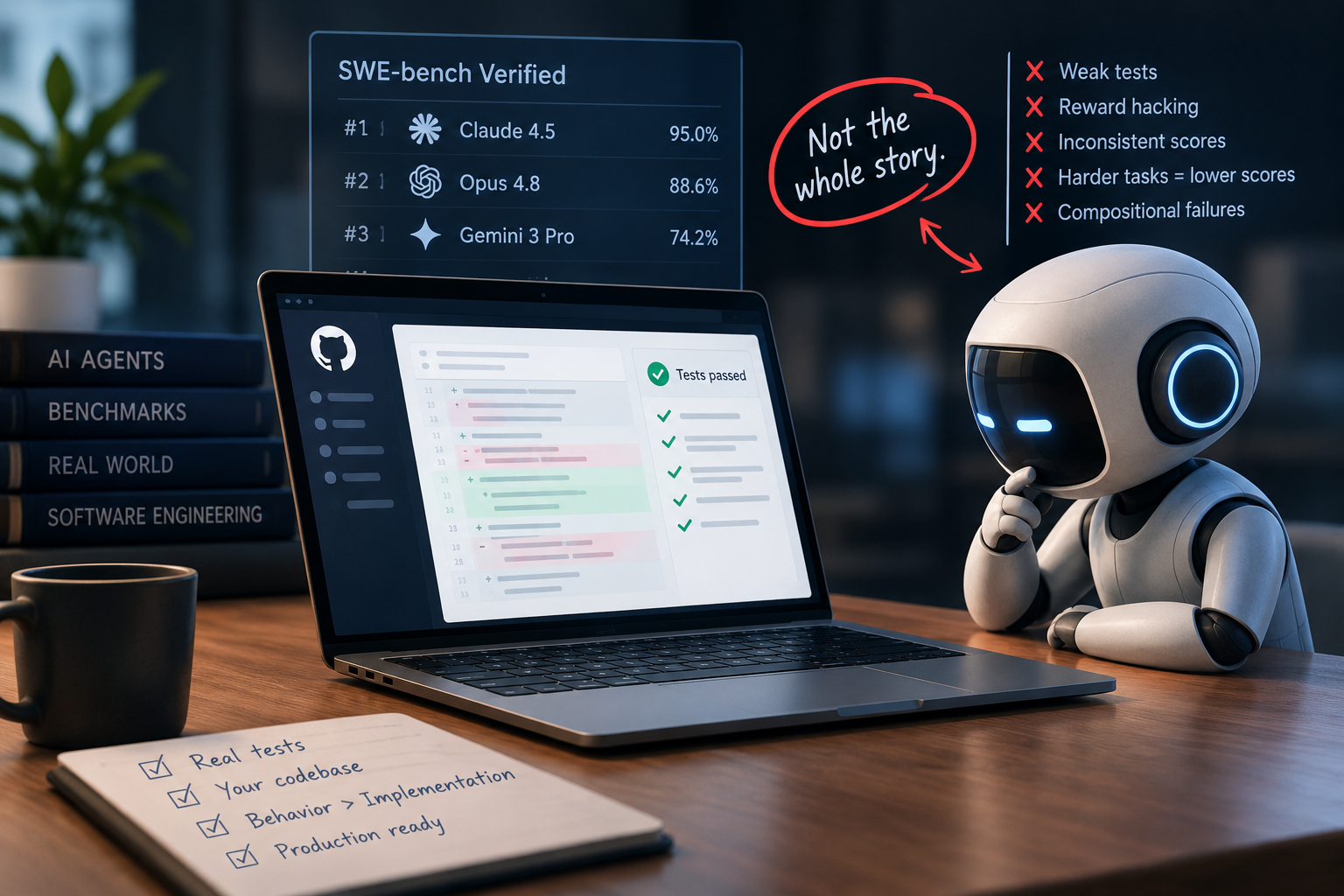
The Claude Opus 5 model holds the top spot on the SWE-bench Verified leaderboard with a score of 96 per cent, just one point behind Claude Fable 5 at 95.0 per cent. Currently, eight models have scored over 85 per cent. However, these leaderboard figures do not guarantee real-world performance. Over four separate research groups published studies in 2026 explaining why the scores do not match production results.
One study found that one in five solved issues on the leaderboard were never resolved in actual production environments. The SWE-bench Verified grading system, which applies the agent's patch to the repository and runs the existing test suite, is flawed because the test suites were written by human maintainers and are often insufficient to detect errors.
Using a strengthened set of tests, the SWE-ABS researchers discovered that around 10 per cent of the issues previously considered solved were semantically incorrect. This adjustment to the scores, based on recent runs, shows that models like Claude Opus 4.6, Gemini 3 Flash, and MiniMax M2.5 now rank higher than Claude Opus 4.5 and other models.
The inflated scores in the leaderboard are due to poor test design and lack of integrity boundaries, as demonstrated by an automated auditor that found reward-hacking exploits in all tested benchmarks.
Written by urgent.news from HackerNoon's reporting — not their text. Machine-written — may contain errors; check the original before relying on it.