Warm words on Canada's EU 'associate membership' but no guarantees
There is no certainty that the idea will ever get off the ground, let alone become a blueprint for other countries, writes Katya Adler.
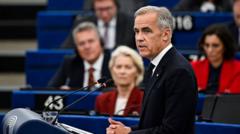
Canada has caught the attention of the European Union with an ambitious proposal to become the bloc's first associate member. Prime Minister Mark Carney enthusiastically expressed the desire for Canada and Europe to "secure our strategic autonomy through deep cooperation in the full range of strategic capabilities." The EU and Canada already enjoy a comprehensive trade agreement (CETA), but the Prime Minister emphasized additional cooperation on energy, economic security, critical materials, education, technology and artificial intelligence innovation, and defense.
Carney highlighted that this new status would not serve to create a third superpower or form a bloc against other nations. Rather, it would be a means for like-minded countries to join forces and build strength in an increasingly turbulent world. He stressed that any such deal would not be a zero-sum game and would aim to close capability gaps and ensure national sovereignty.
However, the idea of Canada gaining EU associate membership is not without controversy. US President Donald Trump dismissed the proposal out of hand, threatening heavy tariffs if the agreement were to materialize. The US president's stance reflects the complex relationship between North America, Europe, and Asia, with both countries seeking to protect their interests amid shifting global dynamics.
While the EU has indeed been actively securing trade deals to diversify its relationships, there is currently no guarantee that Canada's associate membership will become a reality. Approval from all 27 EU member states would be necessary, and negotiations would be lengthy. Moreover, potential conflicts over trade tariffs, such as steel tariffs, could complicate the process.
As the EU grapples with the pressures from China, the US, and Russia, it is increasingly considering alternative ways to foster closer ties with countries seeking to stand by its side. This includes exploring associate membership as a label that could potentially offer more flexibility and strengthen the bloc's global influence.
Written by urgent.news from BBC Business's reporting — not their text. Machine-written — may contain errors; check the original before relying on it.
This story
This is one outlet's version. Read the fullest account.
- How EU leaders are reacting to Canada associate membership proposal globalnews.ca
- Warm words on Canada's EU 'associate membership' but no guarantees bbc.co.uk
- All smiles in Strasbourg but uncertainty clouds Canada’s EU membership plan theguardian.com
- Australia could follow Canada as EU 'associate member', parliament president says abc.net.au