The strange comfort of AI food slop
The cheeseburger on the La Quinta Inn room service handout immediately made my AI antennae tingle. The image—oddly symmetrical, bright, and busy—had something artificial about it. Maybe it was the cheese dripping over the patty in suspiciously triangular form, or the unnatural placement of the accoutrements, but it looked as if a burger emoji made a wish to become real food, and that wish was…
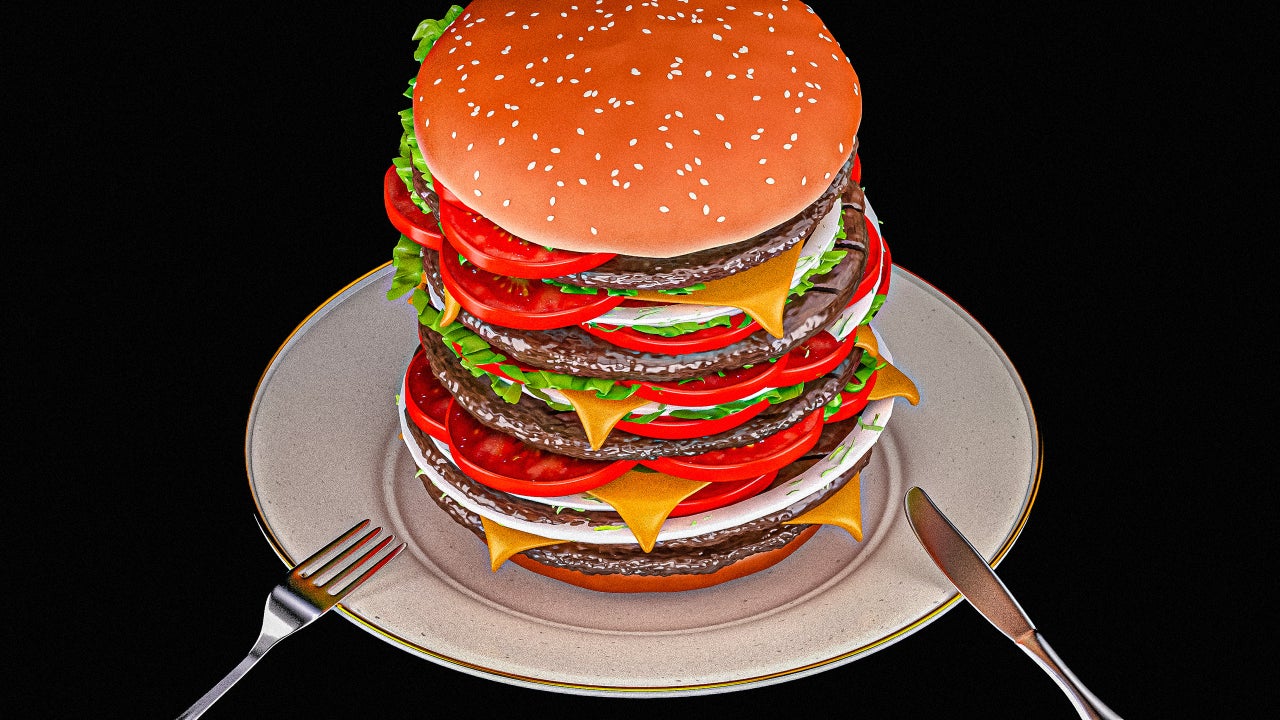
The cheery burger in a La Quinta Inn room service menu leaves an unsettling sensation in my AI sensors. The image, oddly symmetrical, neon, and crowded, carries an artificial quality. Perhaps it's the melty cheese dripping over the patty in an oddly triangular shape, or the misplaced toppings, but it seems as if a burger emoji yearned to become real food, and its wish was only partially granted.
Even though it's off-putting, it doesn't compare to the gastronomical disasters that have been circulating online lately. A plethora of viral food images have been circulating (once again) and none of them are appetizing. What goes viral is the worst of the uncanny: incomprehensible chicken thighs, hive-like burritos, oddly circular shrimp.
While these images are the farthest thing from appetizing, there's a comfort in our ability to immediately identify them as AI. However, experts say that's rapidly changing. AI has already infiltrated much of the food styling and photography world (at least outside of high-end production), and it's only going to become more prevalent and sophisticated.
As AI image generators settle their kinks in rendering food, we're on the precipice of a system entirely dominated by AI. Why AI image generators struggle with food To comprehend a typical bowl of penne pasta: Tubular noodles scatter in a haphazard pile, unevenly doused in sauce and grated Parmesan cheese. As a visual, pasta is textured, random, and filled with varied details—and it's the very kind of thing that AI image generators have historically had trouble replicating.
Professor Ahmed Elgammal of Rutgers University-New Brunswick explains that current off-the-shelf generators employ a stable diffusion model, which compresses images to save computing power. "You're essentially generating a very, very small tiny image and then you're blowing it up later and trying to fill in the details," Elgammal explains.
This omission of features leads to strange outcomes. "That's where food basically falls apart," Elgammal says. "Food is replete with details, and our eyes are scrutinizing all these details because that's how we distinguish good food from bad food or how we gauge food quality." Many of the surreal AI food images we encounter stem from a circular system of unrealistic food imagery that has existed for decades.
Long before AI, companies resorted to practical effects. Campbell's Soup, for instance, added marbles to its soup bowls in advertisements to ensure the ingredients rose to the surface—a tactic among many employed by food stylists to make a photo drool-worthy through less-than-edible means. The advent of Photoshop and other post-production digital technology made it even easier to create a perfect-looking meal.
The images conjured by AI draw on this history of unrealistic depictions of food. As AI image generators refine their techniques, we're poised to witness a system entirely dominated by AI.
Written by urgent.news from Fast Company's reporting — not their text. Machine-written — may contain errors; check the original before relying on it.