The 2003 Virtual World That Let People Build Their Own Reality Before the Metaverse Had a Name
Second Life anticipated today’s creator economy, including its central tension: users can own their creations while platforms control access and income.
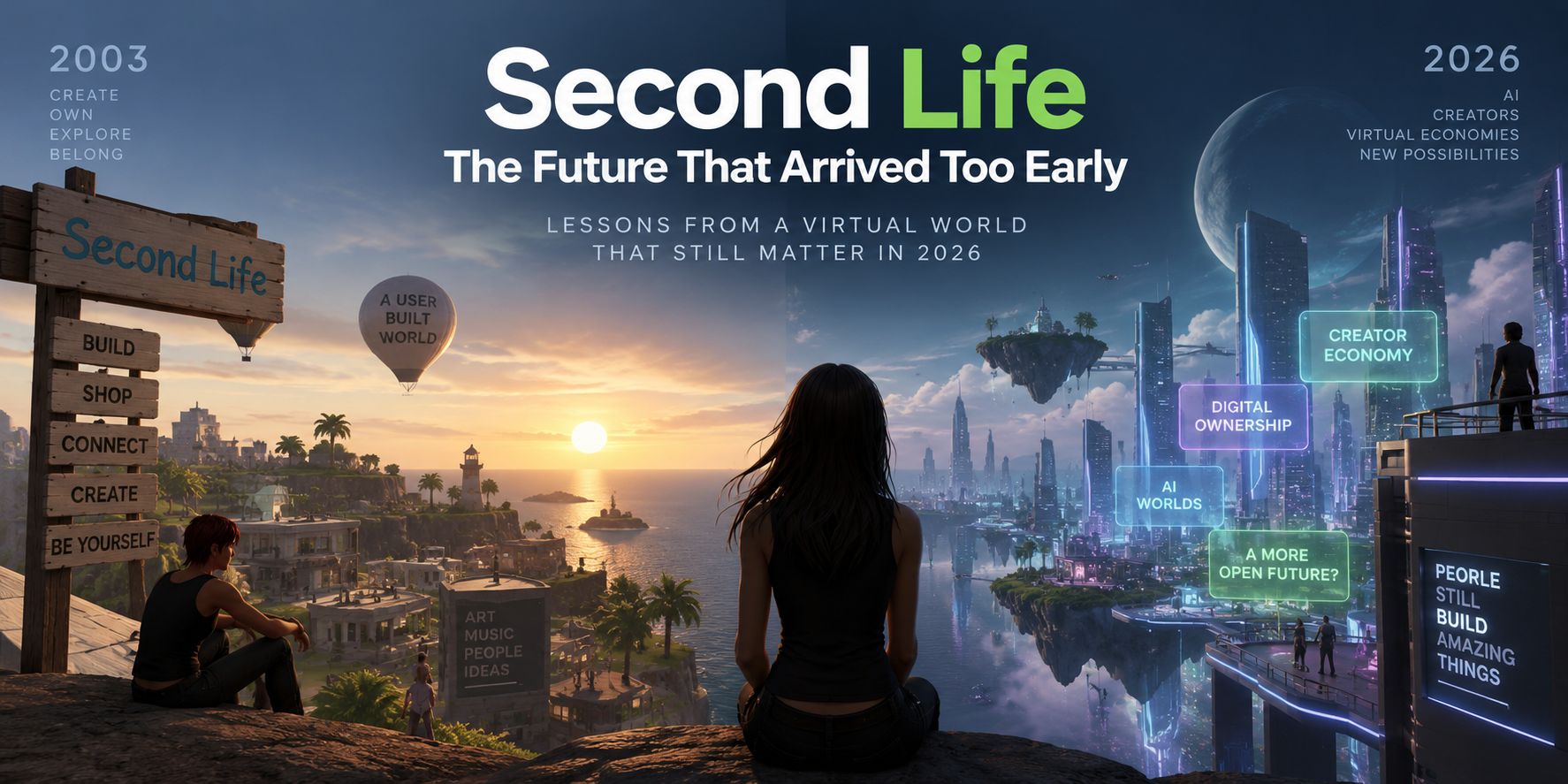
The year 2003 marked the launch of Second Life, a three-dimensional virtual world created by Linden Lab. Unlike other online spaces, Second Life was open-ended, allowing users to create their own avatars, explore spaces built by others, and construct objects and environments themselves. This was possible due to the platform's building system, which utilized primitive geometric objects known as "prims" and the Linden Scripting Language.
The freedom to create was central to Second Life's identity, enabling residents to construct a variety of spaces such as nightclubs, galleries, classrooms, and campuses. However, it's important to note that these creations still relied on infrastructure owned and operated by Linden Lab.
Academic research revealed that residents moved from experimentation to innovation and entrepreneurship within the virtual world. This suggests that user innovation could lead to entrepreneurial opportunities both inside and outside the virtual environment, making Second Life an early example of what we now refer to as the creator economy.
The economy within Second Life was distinctive, with residents using Linden Dollars to buy and sell virtual goods and services, including clothing, objects, land, and experiences. Linden Dollars could also be exchanged for real-world currency via Linden Lab's exchange system. This early example of a virtual economy demonstrated that users could create, trade, and monetize digital goods.
Creators within Second Life retained significant rights over their original content. However, these rights operated within a platform-controlled legal and technical framework. Linden Lab retained control over the servers, accounts, marketplace infrastructure, and enforcement mechanisms, a distinction that remains pertinent when comparing Second Life to contemporary creator platforms.
Today, platforms like Roblox and Fortnite offer similar tools for creators to build interactive experiences, but monetization, discovery, and audience access are more tightly controlled by platform policies and formulas. This creates a tension between creator activity and platform governance, a central issue in today's digital economy.
Despite its limitations, Second Life contributed significantly to education and research. Universities and educators created campuses, classrooms, and simulations within the world, demonstrating how a shared three-dimensional environment could foster communication, participation, and collaboration. This remains relevant today, especially as immersive environments, digital twins, virtual training, and AI-generated spaces are being promoted for work and education.
Second Life attracted considerable media attention in 2006 and 2007, when newspapers, universities, and major companies started viewing it as a potential model for the future of the internet. While it did not become the universally recognized mainstream destination that some predicted, it showcased the potential for persistent online worlds to support user-built environments, social communities, virtual commerce, education, and creative professions over an extended period.
Written by urgent.news from HackerNoon's reporting — not their text. Machine-written — may contain errors; check the original before relying on it.