Robotic lab sets up and runs optics experiments on demand
The autonomous system could speed up testing of high-tech materials for applications such as solar cells, sensors, video displays, and quantum technologies.
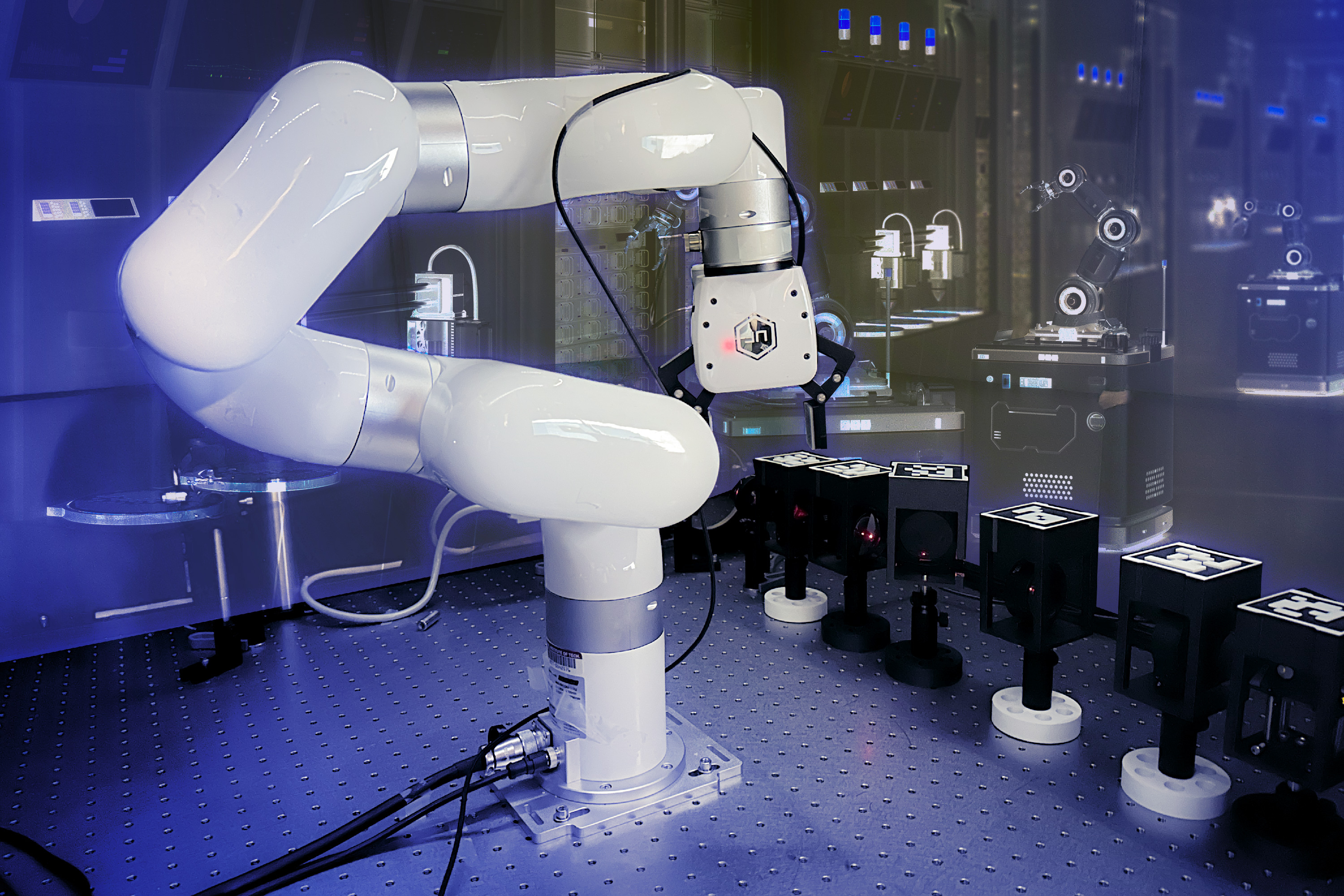
In a groundbreaking advancement, researchers at MIT have developed a fully automated, robotic optics laboratory. This innovative system is capable of autonomously assembling, configuring, and fine-tuning intricate optical experiments with remarkable precision. By eliminating manual labor and tedious adjustments, the robotic lab streamlines the process of creating precision optics for various applications, such as phone displays, televisions, and solar panels.
The system features a robotic arm with seven moveable joints, which picks and places optical components onto a metallic table. Each component is housed in a 3D-printed plastic casing, identified by a QR code containing essential information. The robot uses a fine-adjustment tool equipped with motorized knobs to precisely align mirrors and lenses, achieving micron-scale precision.
The setup is monitored by cameras and controlled by a user-friendly virtual interface, enabling scientists to remotely submit experimental protocols and queries. This fully automated optics laboratory promises to accelerate scientific progress by freeing researchers from repetitive, time-consuming tasks, allowing them to focus on pushing the boundaries of theoretical understanding and innovation.
The MIT team will unveil the details of their robotic lab at an upcoming conference, showcasing the potential of this technology to revolutionize the field of optics.
Written by urgent.news from MIT News Research's reporting — not their text. Machine-written — may contain errors; check the original before relying on it.