Pakistan ranked third-to-last in WEF's Global Gender Gap Report 2026
Pakistan ranked third-to-last in the World Economic Forum’s (WEF) Global Gender Gap Report 2026, with 59.5 per cent gender parity, up almost 3pc from last year . The annual report benchmarked the current state and evolution of gender parity across four key dimensions: economic participation and opportunity, educational attainment, health and survival, and political empowerment. Pakistan scored…
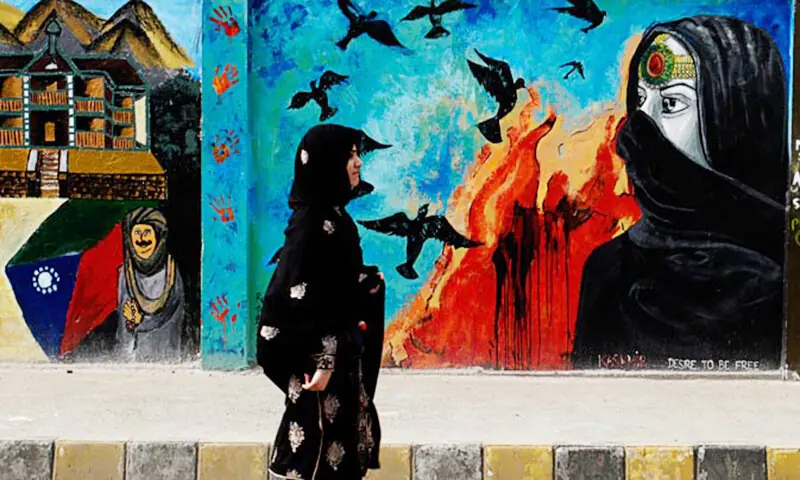
Pakistan has earned the dubious distinction of being ranked third-to-last in the World Economic Forum's (WEF) Global Gender Gap Report 2026, with a gender parity score of 59.5 percent. This marks a 3 percent increase from the previous year, but still lags behind other economies. The report evaluated countries based on four key areas: economic participation and opportunity, educational attainment, health and survival, and political empowerment.
Out of the 38 lower-middle-income economies and seven South Asian countries, Pakistan had the lowest scores in each of these categories.
Pakistan's lack of gender parity is evident in the labour force participation rates, with only 28.21 percent of women working compared to 81.46 percent of men. This disparity is reflected in the country's ranking of 144th in economic participation and opportunity, up three places from last year. The report also highlights the gender gap in leadership positions, with men occupying 96.55 percent of ministerial positions and 93.87 percent of legislative roles in Pakistan. In professional and technical occupations, women make up just 30.96 percent of the workforce.
When it comes to educational attainment, Pakistan has made significant progress. The country ranks 130th in the world for this category, with male literacy at 69.14 percent and female literacy at 48.52 percent. Pakistan leads in tertiary education enrolment, with 10.71 percent of women and 11.01 percent of men pursuing higher education. However, boys still have a slight advantage in primary education enrolment, at 83.01 percent compared to 81.08 percent for girls.
In terms of health and survival, Pakistan ranks 127th globally. The country leads in sex ratio at birth, indicating relatively balanced male and female births. Male and female healthy life expectancies are nearly identical, with male healthy life expectancy at 57.1 percent and female at 56.69 percent. However, Pakistan still has a long way to go in terms of political empowerment, ranking 107th globally.
Only 21.69 percent of parliamentarians are women, and just 3.45 percent of ministerial positions are held by women. Despite having had a female head of state for 4.73 of the last 50 years, Pakistan still lags behind in this subindex.
Written by urgent.news from Dawn's reporting — not their text. Machine-written — may contain errors; check the original before relying on it.