KNUST scientists push for AI-driven solutions to climate and environmental challenges
The College of Science at the Kwame Nkrumah University of Science and Technology (KNUST) has called for stronger integration of climate science, artificial intelligence, and environmental stewardship to address growing resource management challenges in Ghana and the rest of Africa. The call was made at the opening of the 2026 Annual Science Conference of the […]
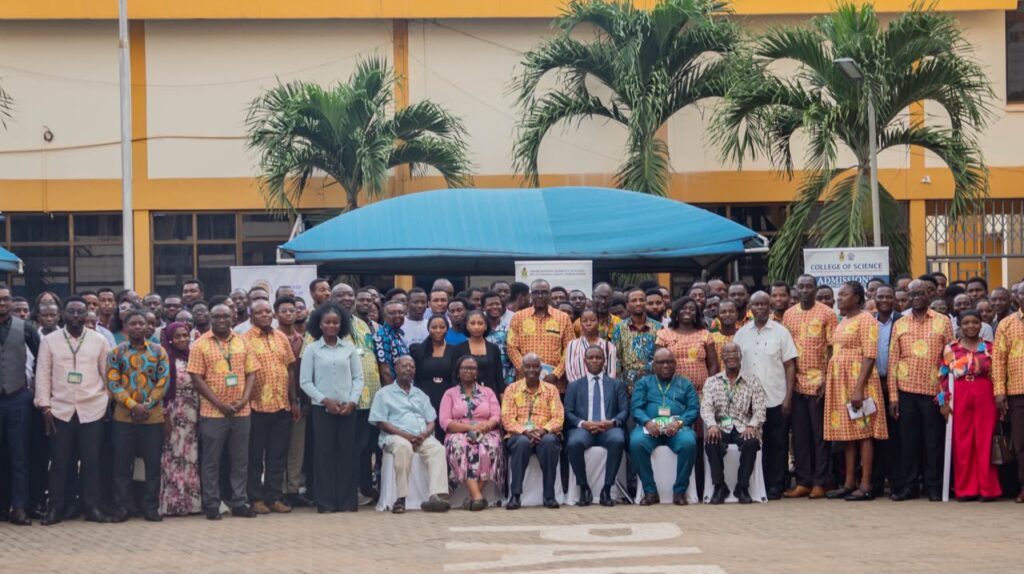
The College of Science at Kwame Nkrumah University of Science and Technology (KNUST) has advocated for greater integration of climate science, artificial intelligence, and environmental stewardship to tackle resource management issues in Ghana and across Africa. This call was made during the opening of the 2026 Annual Science Conference of the College of Science, KNUST, on September 16-17.
The event, organized jointly with the Ghana Science Association (GSA), Kumasi Branch, focused on the theme "Integrating Climate Science, Artificial Intelligence, and Environmental Stewardship for Sustainable Resource Management in a Changing World." Attendees included academics, researchers, postgraduate students, industry partners, policymakers, and other stakeholders who gathered to explore how scientific innovation and emerging technologies can address pressing environmental challenges.
Prof. Philip Antwi Agyei, Provost of the College of Science, KNUST, emphasized the relevance of this theme in the face of significant environmental and technological changes. He highlighted that climate change is causing shifts in rainfall patterns, rising temperatures, extreme weather events, and putting pressure on food systems, water resources, ecosystems, and livelihoods.
Additionally, factors like rising sea levels, biodiversity loss, population growth, urbanization, and increased consumption are further stressing natural resources. Prof. Antwi Agyei also pointed out that rapid advancements in artificial intelligence, big data, machine learning, remote sensing, and computational technologies offer new opportunities for scientists to better understand and respond to these challenges.
However, he stressed the importance of responsible governance, urging participants to consider ethical considerations, equity, data ownership, privacy, access, and accountability when applying AI. Prof. Antwi Agyei noted that while the connection between climate science, AI, and environmental stewardship is clear, the focus should now be on how these disciplines can be combined to create solutions relevant to African societies.
He challenged African scientists to not only observe technological and scientific developments elsewhere but also to actively shape those developments. Prof. Antwi Agyei encouraged participants to explore how climate science can inform AI, how AI can enhance climate predictions and environmental management, and how environmental stewardship can guide technological innovation.
Prof. Alexander Kwarteng, President of the Ghana Science Association, echoed the need for stronger systems to translate scientific talent into impact in Ghana. He identified research infrastructure, funding, actionable policies, and a culture of collaboration as essential for advancing science and innovation in the country. Prof. Kwarteng emphasized the importance of integrating climate change, artificial intelligence, and environmental stewardship, describing the convergence of these fields as increasingly vital for responding to future challenges.
He stressed the need for collaboration among researchers and institutions, encouraging participants to identify potential collaborators and explore joint research opportunities. Both speakers highlighted the significant impact of climate change on Africa, noting that despite contributing less than four percent of global carbon emissions, Africa is expected to face severe consequences.
They emphasized the urgency of addressing this injustice through research, data, and solutions developed with African realities in mind. The two-day conference aimed to foster discussions on climate resilience, sustainable resource management, artificial intelligence, and responsible technological governance, positioning African scientists to make significant contributions to global solutions.
Written by urgent.news from Adom Online's reporting — not their text. Machine-written — may contain errors; check the original before relying on it.