Kashmir cracks walnut success code, turns to medium-sized, grafted trees
In the Gohan village, situated around 100km south of Srinagar, Shabir Ahmad joined many others in the laborious task of harvesting walnuts from towering trees. Ahmad, who has been engaged in this activity for generations, expressed that the work has become increasingly arduous, citing back pain as a consequence. Despite the challenges, Ahmad proudly mentioned that his family has been harvesting walnuts in this manner for centuries, adding that he is also a clerk at a local court.
However, the benefits of this traditional practice are overshadowed by the risks involved. Dr. Mohd Yaqoob Bhat, a surgeon at Paras Hospital in Srinagar, reported that healthcare units in the Valley treat dozens of patients annually due to falls from walnut trees, some of whom suffer serious spinal injuries. Bhat expressed concern over the absence of any mechanism to address this issue.
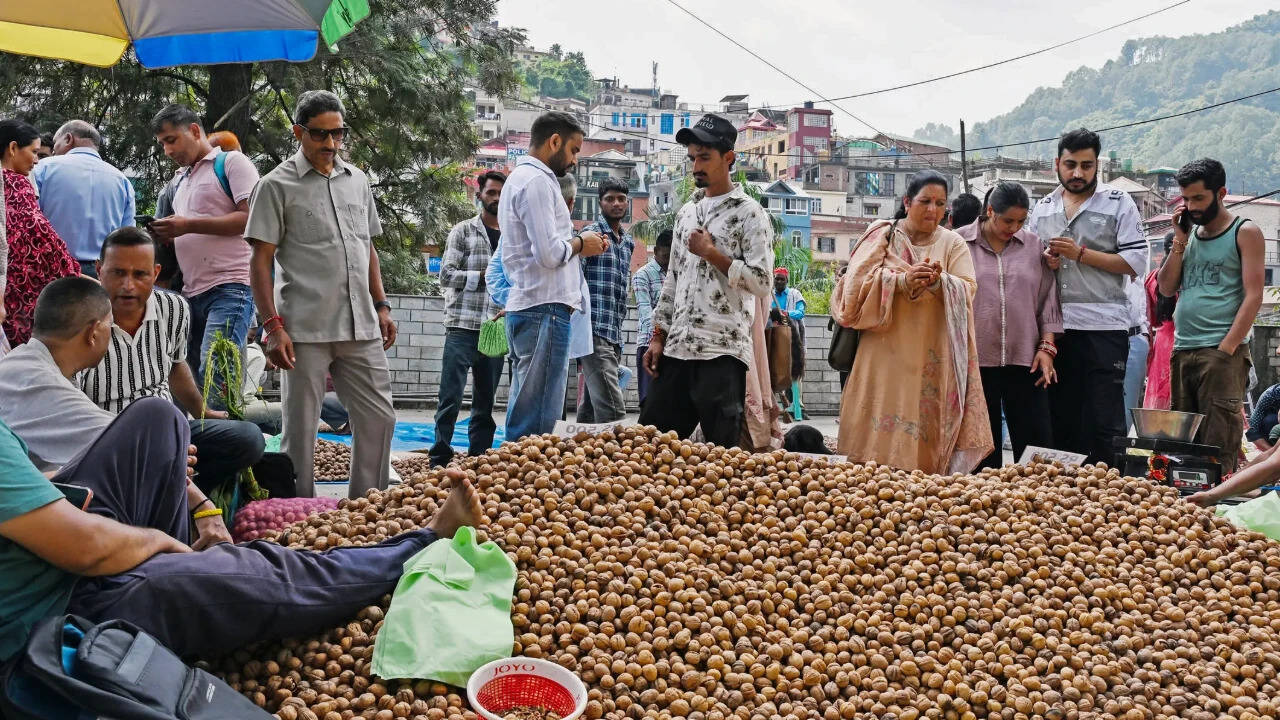
Ahmad's younger brother, on the other hand, sold each walnut at a rate of one rupee, highlighting the stark differences in the appearance of each fruit. For centuries, Kashmir's walnut trees were propagated through seeds, but now, the Jammu and Kashmir (J&K) government, along with Sher-e-Kashmir University of Agricultural Sciences and Technology (SKUAST), are promoting medium-sized, grafted walnut trees to enhance uniformity and improve competitiveness in the global market, primarily due to the rise of soft-shelled varieties from California and Chile.
The initiative aims to replace the existing scattered plantations with organized orchards consisting of known tree varieties, allowing farmers to cultivate more trees within the same land area and produce walnuts with consistent sizes and colors. J&K currently has approximately 80,000 hectares under walnut cultivation, with most of these areas comprising seedling-origin trees.
Dr. Ashfaq A. Pandit, professor and head of fruit science at SKUAST, explained that every tree that grows from a walnut seed is a unique variety, emphasizing the challenge posed by natural variation in the current market scenario where uniformity is highly sought after.
J&K's walnut trees typically require around 15 years to bear fruit without the use of any pesticides. In contrast, grafted walnut trees belong to known varieties and are genetically consistent. Imtiyaz Ahmad Lone, professor and head of SKUAST’s Walnut Research Centre, announced that the university has introduced new walnut cultivars, and grafting-based cultivation has expanded to nearly 90,000 hectares, even without any subsidies.
However, farmers like Mohammad Sultan, a Pulwama farmer with 50 years of experience, argue that the grafted varieties fall short in terms of taste compared to the traditional Kashmiri walnut, which they consider to be more flavorful and robust. Lone countered this argument by pointing out that grafted trees offer earlier bearing, faster returns, and uniform nut quality, thereby increasing productivity and export potential.
Written by urgent.news from Times of India's reporting — not their text. Machine-written — may contain errors; check the original before relying on it.