90% Link Fraud Infrastructure to Faster Customer Onboarding
Fraud prevention is no longer a cost center, and for many firms, has become an investment with a measurable return. “Payment Protection: Why Firms Still Aren’t Real-Time Ready,” a PYMNTS Intelligence report produced in collaboration with Plaid, finds that companies modernizing payments report lower fraud losses, fewer failed payments and reduced operating costs. The report […] The post 90% Link…
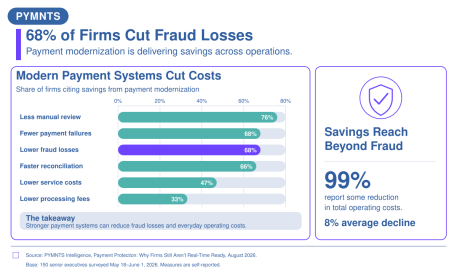
Modernizing payment infrastructure is no longer viewed as a cost center, but rather an investment that yields measurable returns for many firms. According to a PYMNTS Intelligence report in collaboration with Plaid, companies that modernize payments report lower fraud losses, fewer failed payments, and reduced operating costs. The survey of 150 senior executives from mid-market and enterprise firms in seven industries moving significant amounts of money revealed that 99% of respondents experienced a reduction in total operating costs, with an average decline of 8%.
Fraud savings are observed across operations, with 68% of firms citing lower fraud losses, 60% experiencing faster fraud detection, and 76% reducing manual review and workload. Faster reconciliation and reporting also saved 66% of firms. Real-time verification allows for immediate or within-minute detection of fraud, which is especially crucial for real-time payments that cannot be reversed after settlement.
Customers also benefit, with 87% of executives linking modernized payment infrastructure to fewer customer-service inquiries, the same percentage reporting fewer late or missed payments, 83% citing higher customer satisfaction, 81% experiencing fewer payment complaints, and 80% noting stronger retention. Despite these gains, 57% of firms reported an increase in fraud attempts in the previous year, and 47% could not detect suspected fraud in real time or within minutes.
Additionally, only 49% use secure bank connectivity to generate real-time fraud signals from account activity, even though nearly all firms already possess this connectivity. Looking ahead, 70% of firms plan to adopt or expand payment reconciliation automation, 65% intend to implement identity verification and know-your-customer automation, and 59% aim for secure bank connectivity or artificial intelligence-based fraud detection over the next 12 months.
These improvements demonstrate that fraud controls can yield benefits beyond merely avoiding losses. With fraud controls already available, the next step for many firms will be to utilize them more broadly to generate additional returns.
Written by urgent.news from PYMNTS's reporting — not their text. Machine-written — may contain errors; check the original before relying on it.