Why MLOps Pipelines Need Security Audits
A practical SecMLOps experiment shows how Apache Airflow ML pipelines can adopt DevSecOps controls for secrets, validation, artifact integrity and auditable security evidence.
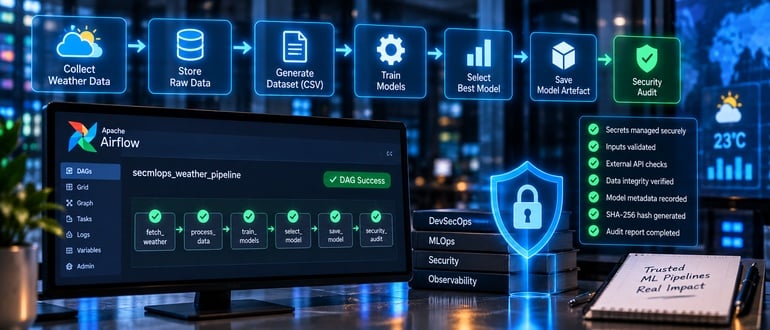
Modern DevOps practices have long emphasized testing, logging, and auditability in software delivery pipelines. Similarly, machine learning pipelines require comparable safeguards. Though they do not deploy traditional applications, ML pipelines collect data, generate artifacts, and impact production decisions.
This article demonstrates a practical experiment in SecMLOps (Security for Machine Learning Operations) using Apache Airflow. The experiment extends a simple weather ML pipeline with security controls that align with DevSecOps principles: secret separation, runtime validation, external boundary checks, artifact integrity, and audit evidence.
Simply obtaining a green DAG is insufficient; a successful task may still generate an untrusted artifact. Malformed runtime values, incomplete data from external APIs, and lack of metadata are possible pitfalls.
The SecMLOps architecture for the Airflow weather pipeline incorporates security measures throughout the workflow. Weather data is collected from OpenWeatherMap and stored as raw JSON files. CSV datasets are generated, regression models are trained, the best model is selected, and a model artifact is saved. To enhance security, the experiment introduces a layer of controls to these operations.
Control purposes in this SecMLOps version include maintaining API keys and runtime values outside the source code, rejecting invalid city names before making external API calls, failing fast when the external boundary returns unexpected results, preventing the training of datasets from unusable CSV files, and recording the selected model, score, features, row count, and timestamp.
An SHA-256 model hash provides a verifiable identity for model artifacts. Finally, a final security audit task generates evidence that the expected outputs exist and have passed the aforementioned checks.
Written by urgent.news from DevOps.com's reporting — not their text. Machine-written — may contain errors; check the original before relying on it.