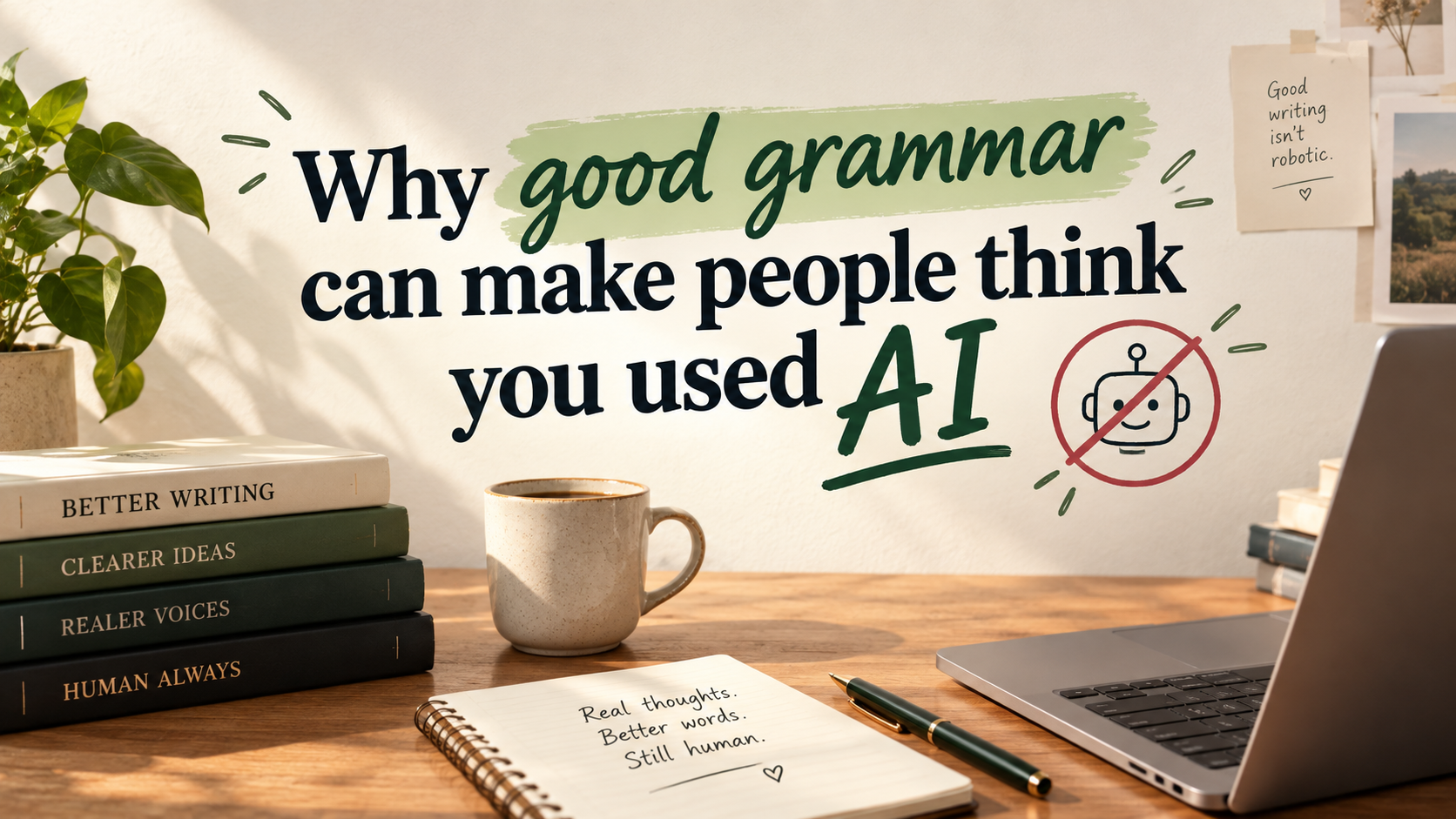
Why good grammar can make people think you used AI
As AI tools become common, polished grammar and clear writing are increasingly being mistaken for machine-generated content.
For a considerable period, impeccable grammar was considered a sign of intelligence, professionalism, and attention to detail. Writers were urged to revise their work, expand their vocabularies, and express themselves clearly. However, in recent times, some writers have encountered an unforeseen issue: their well-crafted writing is being mistaken for content created by artificial intelligence.
As digital assistants like ChatGPT, Gemini, and Claude gain popularity, readers are encountering more text that is grammatically accurate, organized, and easy to comprehend. This development has resulted in an unexpected change in perception. In some instances, writing that is overly polished may lead people to question whether artificial intelligence was employed. There are four reasons why flawless grammar can sometimes indicate the use of AI.
1. AI tools are known for producing polished writing. Current AI tools excel at generating neat, well-structured text with consistent grammar and a smooth flow. As individuals come across more AI-generated writing, they might begin associating these attributes with artificial intelligence. Meanwhile, ordinary human communication often contains more imperfections.
Typos, omitted punctuation, abbreviations, and incomplete thoughts are common in everyday written communication, especially in messages and posts on social media. Consequently, highly polished writing might occasionally arouse suspicion, even when it was composed by a person. Good grammar simply reflects meticulous drafting, editing, and practice.
2. The rise of AI detection tools has heightened awareness and skepticism. In educational institutions, workplaces, and publishing environments, the use of AI-detection tools has grown significantly. These tools aim to identify content generated by artificial intelligence. As conversations surrounding AI detection become more frequent, people have become more cautious when assessing written material.
However, AI detectors are not always reliable. Sometimes, human-authored content may be mistakenly flagged as AI-generated, while AI-produced text could sometimes evade detection. This situation has led some writers to face inquiries about work they created entirely independently.
3. Good writing and AI-generated writing often share similar qualities. For several decades, writing instructors have instructed students to cultivate habits such as: employing correct grammar and punctuation, structuring ideas logically, maintaining a consistent tone, composing clear and succinct sentences, and establishing smooth transitions between paragraphs.
Ironically, these very characteristics are the ones that many AI systems are designed to emulate. Since AI systems learn from vast volumes of human-written material, they frequently reproduce the traits typically associated with proficient writing. This similarity can make it challenging for readers to differentiate between well-written human content and AI-generated text.
4. People are placing greater emphasis on authenticity than grammar. As AI-generated content becomes more prevalent, some readers are increasingly focusing on aspects beyond grammar when determining whether a piece feels genuine. Personal experiences, original observations, emotional depth, and unique perspectives are frequently viewed as more significant indicators of authenticity than sentence structure alone.
A perfectly grammatical article might still seem impersonal, whereas a piece with a distinct voice can feel unmistakably human. This shift in perspective has altered how many individuals evaluate writing in the era of artificial intelligence.
Written by urgent.news from YourStory's reporting — not their text. Machine-written — may contain errors; check the original before relying on it.