When Stars Engulf Rocky Planets, Beryllium Gives It Away
Astronomers know that stars can engulf planets when they stray too close. But how can they know, by looking at a star, if it has ever done so? The answer lies in Beryllium, an element not synthesized inside stars.
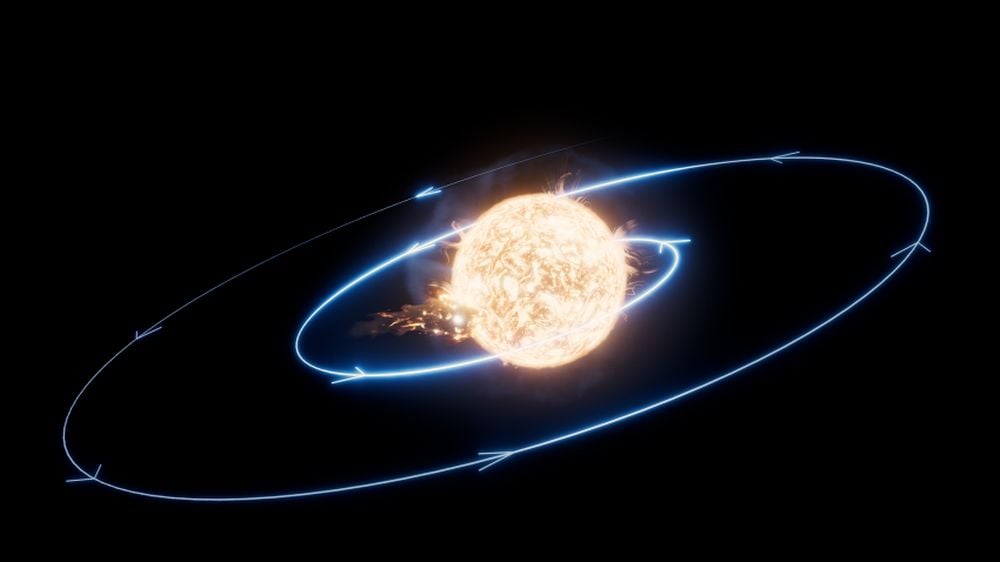
When stars consume rocky planets, beryllium reveals it. An international team of researchers has developed a method to determine if stars have devoured world-sized rocks orbiting close to them. This discovery could have implications for the habitability of planets in our own Solar System. The study, titled "Planet engulfment in the chemically anomalous HD 129171/HD 129209 pair," is set to be published in Astronomy and Astrophysics.
The first author, Anne Rathsman, a doctoral student at the Institute of Astronomy, Geophysics, and Atmospheric Sciences in Brazil, focused on two stars akin to our Sun in magnetic activity, chemistry, and physical attributes. These stars, named HD 129171 and HD 129209, form a binary system located approximately 180 light years away.
Despite their similarities, these stars exhibit different abundances of beryllium, a rare element that makes up only 0.0004% of Earth's crust. The differences in beryllium abundance suggest that HD 129171 has engulfed a rocky planet in its past, absorbing about 11 Earth masses of rocky material. Astronomers have hypothesized that one of the stars has absorbed a rocky planet, which could explain the differences in their chemical composition.
To confirm this hypothesis, the researchers measured precise differential abundances in the pair. Their work relied on observing the spectra of the stars using the VLT and its Ultraviolet and Visual Echelle Spectrograph (UVES). They focused on beryllium, one of the refractory elements, which is typically found in rocky planets. The presence of higher beryllium and lithium abundances in HD 129171 compared to HD 129209 indicates that it has likely engulfed planetary material during its evolution.
Beryllium's resistance to stellar nucleosynthesis makes it a reliable indicator of planetary engulfment, unlike lithium, which is easily destroyed during the main sequence phase of Sun-like stars. The researchers used beryllium abundance to estimate the amount of rocky material absorbed by HD 129171, finding a match with the model of engulfing about 11 Earth masses of rocky material.
This finding suggests that our Solar System might be exceptionally rare, as simulations struggle to create systems similar to ours, where massive planets maintain stable, low-eccentricity orbits and rocky planets in the inner system follow stable orbits. If planetary engulfment is common, it implies that many systems undergo violent dynamic phases, potentially threatening the stability of inner planets and the survival of life.
Written by urgent.news from Universe Today's reporting — not their text. Machine-written — may contain errors; check the original before relying on it.