The universe's most extreme dead stars can form from vampire white dwarfs — and scientists finally know how
Some vampire white dwarfs that feed on companion stars can transform into neutron stars, but like a cosmic Goldilocks, conditions must be "just right" for this extreme makeover.
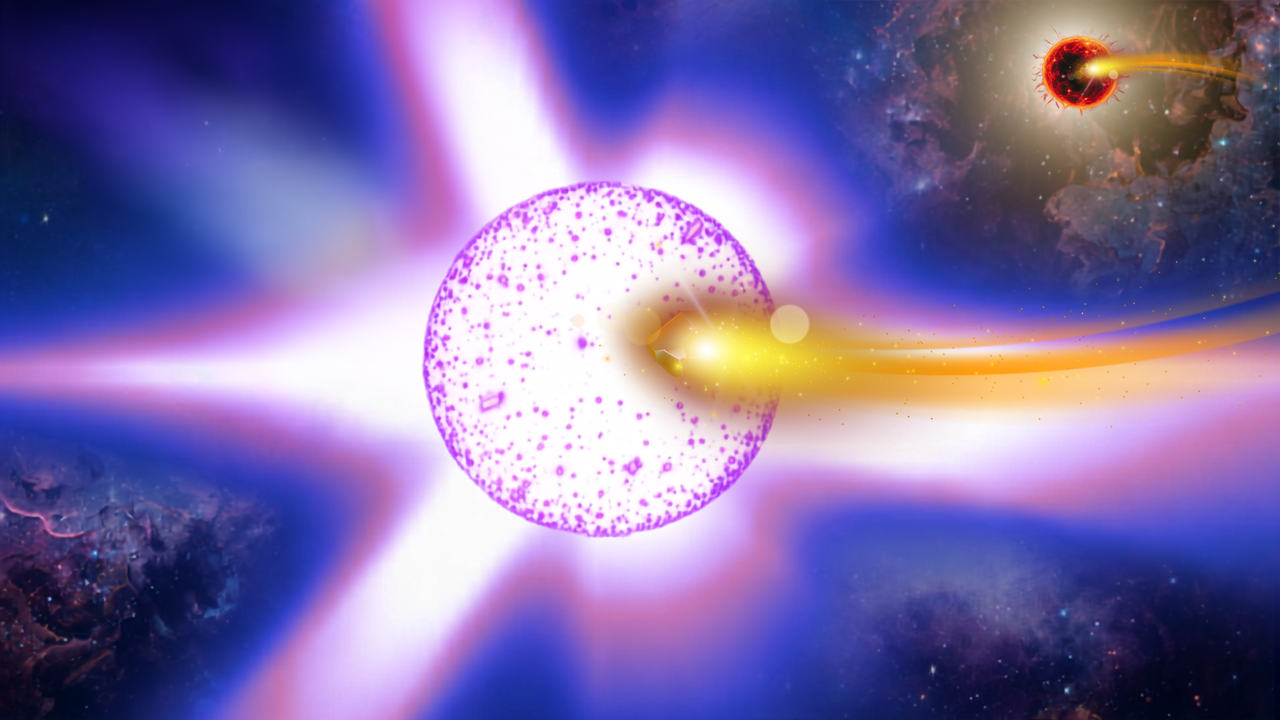
White dwarfs are the remnants left behind when stars like our sun die. These remnants can transform into neutron stars, which are the densest objects in the universe. However, the transformation requires specific conditions to be met. Scientists have found that a white dwarf must be "feeding" on a companion star to undergo this conversion.
This process, called accretion-induced collapse (AIC), involves the white dwarf gaining mass from its companion until it reaches a critical point called the Chandrasekhar limit. At this point, the white dwarf collapses into a neutron star.
The key difference between AIC and the more common route to neutron star formation is that in AIC, there is no thick envelope of material surrounding the collapsing white dwarf. This results in a faint and fast transformation, with less matter being ejected compared to an ordinary supernova. However, not all white dwarfs can undergo AIC.
They must have a specific composition and mass, typically being more carbon and oxygen-rich than the more common carbon-oxygen white dwarfs. Additionally, the accretion rate of material from the companion star must be within a narrow range for the transformation to occur. If the accretion rate is too low, the white dwarf will lose its gained mass through novae. If it's too high, the white dwarf will not reach the necessary conditions for collapse.
Written by urgent.news from Space.com's reporting — not their text. Machine-written — may contain errors; check the original before relying on it.