Reading Fault Stress from the Rhythm of Earthquakes
T-rate, a new Bayesian tool that reconstructs changing fault stress from earthquake rates, reveals a late stress increase before the 2008 Reno–Mogul magnitude 5.1 earthquake.
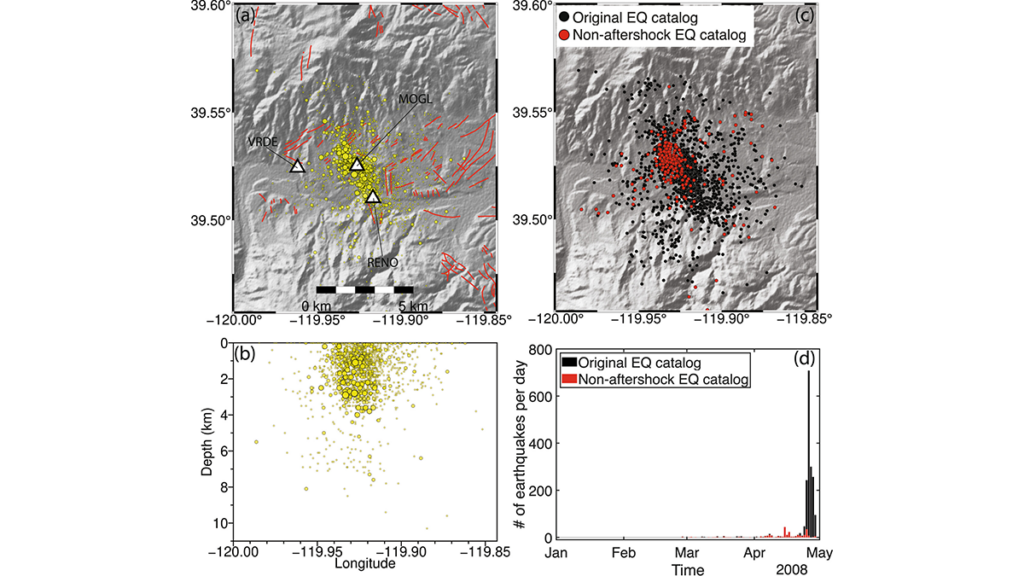
Earthquakes can reveal fault stress patterns by changing their frequency, according to a new study. Jiang et al. [2026] developed a method called T-rate, a Bayesian approach that evaluates various stress history scenarios to reconstruct changes from earthquake records and estimate associated uncertainties. The method models each stress loading episode as a flexible rise, steady phase, and decline.
Simulations with earthquake sequences demonstrate that T-rate can recover complex stress histories under different conditions. When applied to a 2008 Reno-Mogul earthquake swarm, the preferred model identifies four loading phases, including a sharp increase starting roughly three days before the magnitude 5.1 quake. The timing of this late rise remains stable across various data-processing choices.
When combined with independent GPS measurements of ground deformation and observations of rapid earthquake migration, the findings suggest slow fault motion without detectable earthquakes as a likely cause of the final loading phase. The open-source T-rate tool turns widely available earthquake records into uncertainty-aware estimates of stress evolution, complementing ground-deformation measurements, particularly in areas with sparse data, and aids studies of earthquake swarms and other transient fault processes.
The research is published in the Journal of Geophysical Research: Solid Earth by authors Y. Jiang, D.T. Trugman, and P.J. González in 2026.
Written by urgent.news from Eos's reporting — not their text. Machine-written — may contain errors; check the original before relying on it.