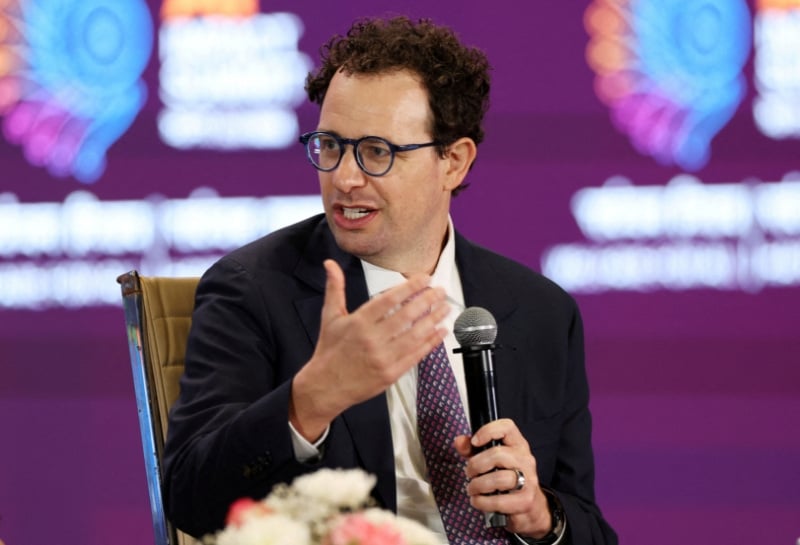
Meta's Mark Zuckerberg says AI labs have enough incentive to build safely
Meta Platforms CEO Mark Zuckerberg said on Tuesday that competition and liability give AI companies enough reason to act individually on safety, appearing to break from calls by leaders of top AI firms for a coordinated slowdown in AI development.

Meta Platforms CEO Mark Zuckerberg stated on Tuesday that competition and liability provide artificial intelligence companies with sufficient motivation to independently prioritize safety, seemingly diverging from calls by leaders of leading AI firms for a collective slowdown in AI development. The comments highlight a divergence among industry executives and U.S. authorities regarding the appropriate response to warnings that the technology is advancing more quickly than companies can manage it, with some insiders expressing concerns that the technology poses an existential threat to humanity.
Zuckerberg emphasized in an X post that each lab has the responsibility and incentive to maintain the pace necessary to train models safely and has the capability to take its own measures to ensure this. His remarks come three days after Anthropic CEO Dario Amodei advocated for AI companies to slow the pace of model capability improvements, following existential risk warnings from several researchers.
Rival OpenAI CEO Sam Altman and xAI founder Elon Musk both endorsed Amodei's call within hours. President Donald Trump, however, downplayed concerns about the potential for AI to cause harm on Monday, stating that the U.S. already has safeguards in place for the technology and that China could benefit from skepticism about AI's development.
Tech executives, such as Nvidia CEO Jensen Huang, share the view that regulatory hurdles could harm the U.S.'s ability to compete against Chinese counterparts. Zuckerberg highlighted trust and alignment as crucial capabilities that differentiate AI agents and models, stressing that any lab neglecting alignment would fall behind.
He also disclosed that Meta delayed the launch of its Muse AI agent this year to enhance security. Zuckerberg clarified that Meta had not requested other companies to follow suit but took this action as part of its routine work due to its perceived importance for both people and the company. While Amodei called for an industry-wide reduction in recursive self-improvement - AI's capability to enhance itself - Zuckerberg noted that Meta had already allocated the majority of its computing resources to produce products that address users' immediate needs rather than pursuing self-improving AI systems.
Meta Superintelligence Labs, Meta's AI division, already employed independent evaluators across various areas, calling it industry best practice and encouraging other labs to do the same. Zuckerberg's efforts to present Meta as a responsible actor in AI safety follow the company's recent agreement to potentially pay up to $18 billion to settle U.S. state lawsuits alleging that it designed Facebook and Instagram to be addictive to children, without admitting any wrongdoing.
The uncertainty surrounding a coordinated approach by AI firms is further compounded by FTC Chairman Andrew Ferguson, who stated on Tuesday that everyone should be deeply suspicious of AI companies seeking antitrust exemptions while advocating for new regulations, although he did not specifically mention Anthropic, whose CEO made the earlier appeal for a slower AI development pace due to safety concerns.
Written by urgent.news from Economic Times Tech's reporting — not their text. Machine-written — may contain errors; check the original before relying on it.
This story
This is one outlet's version. Read the fullest account.
- Mark Zuckerberg is outsourcing his thinking to AI. It shows in his new ‘personal AI agent’ experiment fortune.com
- Mark Zuckerberg says AI labs have the responsibility and incentive to train models safely and that any lab that doesn't focus on alignment will fall behind (Mark Zuckerberg/@finkd) x.com