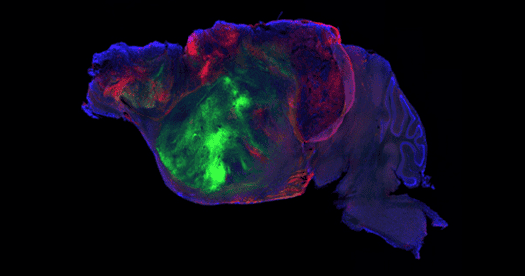
Meet a mouse whose brain cortex is made up of human cells
Multiple cameras tracked a mouse as it wandered around a small arena. A computer charted its position and speed, leaving Pong-like traces on a monitor. The reason to watch this rodent so carefully? Nearly half its brain volume had been replaced with human cells. The effort to mix the brain tissues of distant species is…
A team of researchers at Stanford University has created a unique mouse with a brain cortex made up of human cells. The study, published in the journal Nature, involved genetically modifying mice so that their brains did not fully develop. This left plenty of space for human cells to take hold. The modified mice were missing most cells of the cortex and hippocampus, two crucial brain areas.
As a result, the human cells were able to divide and grow, filling most of the available space within a few weeks to months. The researchers then tracked the movements of one of these mice in a small arena, using multiple cameras to monitor its position and speed. The resulting data was charted in a computer-generated trajectory, revealing the rodent's behavior.
While the genetically modified mice appeared normal in their movements and vocalizations, they showed significant memory impairments. In contrast, mice that had the human cells added to their brains performed better on maze tests, indicating that the human tissue was playing a role in their cognitive functions. The researchers believe that these "xenocortical mice" could be valuable tools for studying brain injuries.
The study also highlights the potential of combining genetic engineering and stem-cell technology to reshape biological systems. However, the researchers emphasize that further experiments should not be conducted on higher species, as such manipulations could lead to significant cognitive blurring between humans and animals.
Written by urgent.news from MIT Tech Review Biotech's reporting — not their text. Machine-written — may contain errors; check the original before relying on it.
This story
This is one outlet's version. Read the fullest account.
- Meet a mouse whose brain cortex is made up of human cells technologyreview.com