Building a Tamper-Proof, 60 FPS Real-Time Arcade Engine
Learn how to build a server-authoritative Web3 game backend with deterministic replay, anti-cheat validation, Redis leaderboards, WebSockets, and RBAC.
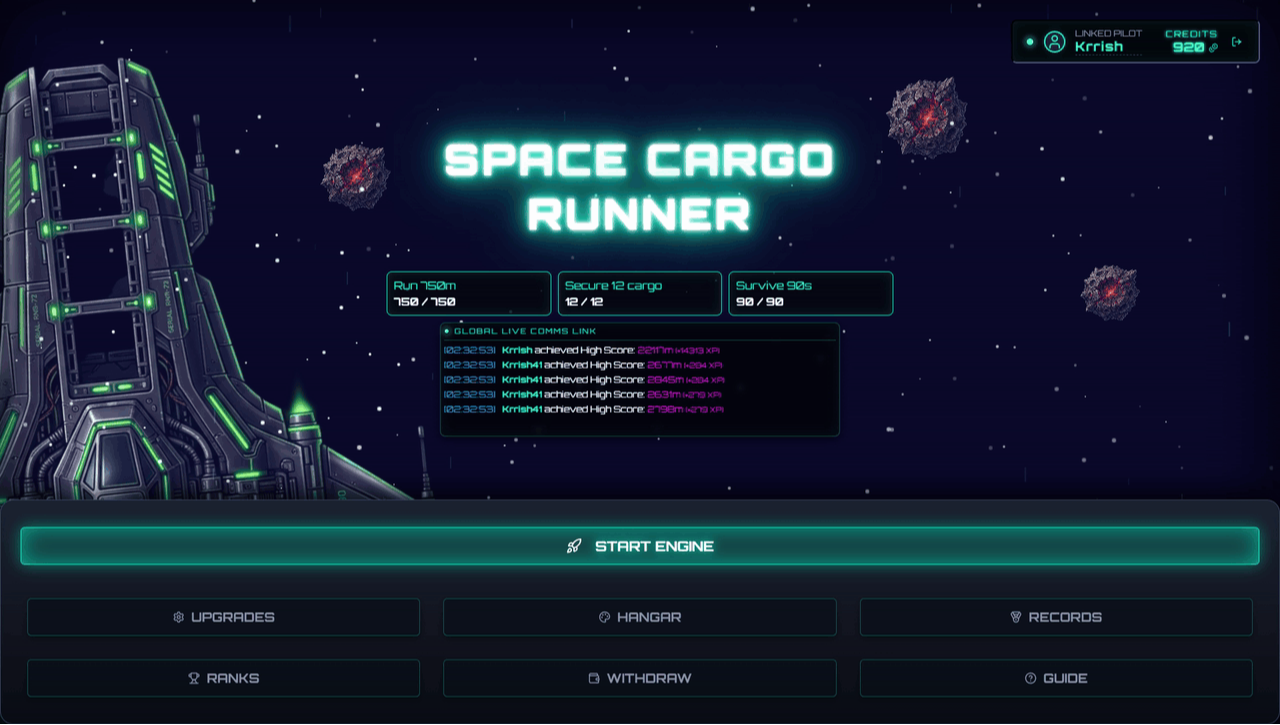
Creating a game engine capable of 60 frames per second in real time presents significant engineering hurdles. Space Cargo Runner, a cyberpunk-themed Web3 arcade runner, faced this exact challenge. The core difficulty was not rendering graphics smoothly, but building a backend system that could keep player state synchronized seamlessly without any dropped frames.
React's standard approach to updating game state on every frame proved disastrous, causing catastrophic CPU bottlenecks and ruined frame rates. The solution was to decouple the game loop from React's DOM and leverage Zustand as a state mediator. Zustand acts as a bridge allowing the Phaser 3 game engine to update telemetry such as fuel, health and cargo counts at 60 FPS without interfering with React's reconciliation process.
Server-authoritative anti-cheat mechanisms were also essential given the potential for fraud in acquiring token rewards and cryptocurrency. The client streams timestamped gameplay actions and an initial PRNG seed to the server. A deterministic replay engine verifies the claimed cargo and survival time mathematically matches the game state generated by the seed. Validated scores are then posted to an atomic ledger using Prisma transactions with idempotency keys.
WebSocket leaderboards fan out to active sessions in sub-100ms latency. Redis sorted sets efficiently store and query scores. The entire codebase is organized as an npm monorepo with shared TypeScript interfaces between client, server and smart contracts preventing runtime contract mismatches. This system ensures the backend remains tamper-proof while delivering the necessary performance for a smooth, competitive arcade experience.
Written by urgent.news from HackerNoon's reporting — not their text. Machine-written — may contain errors; check the original before relying on it.