APOD: 2026 September 16 – Webb’s View of M64
The post APOD: 2026 September 16 – Webb’s View of M64 appeared first on NASA Science .
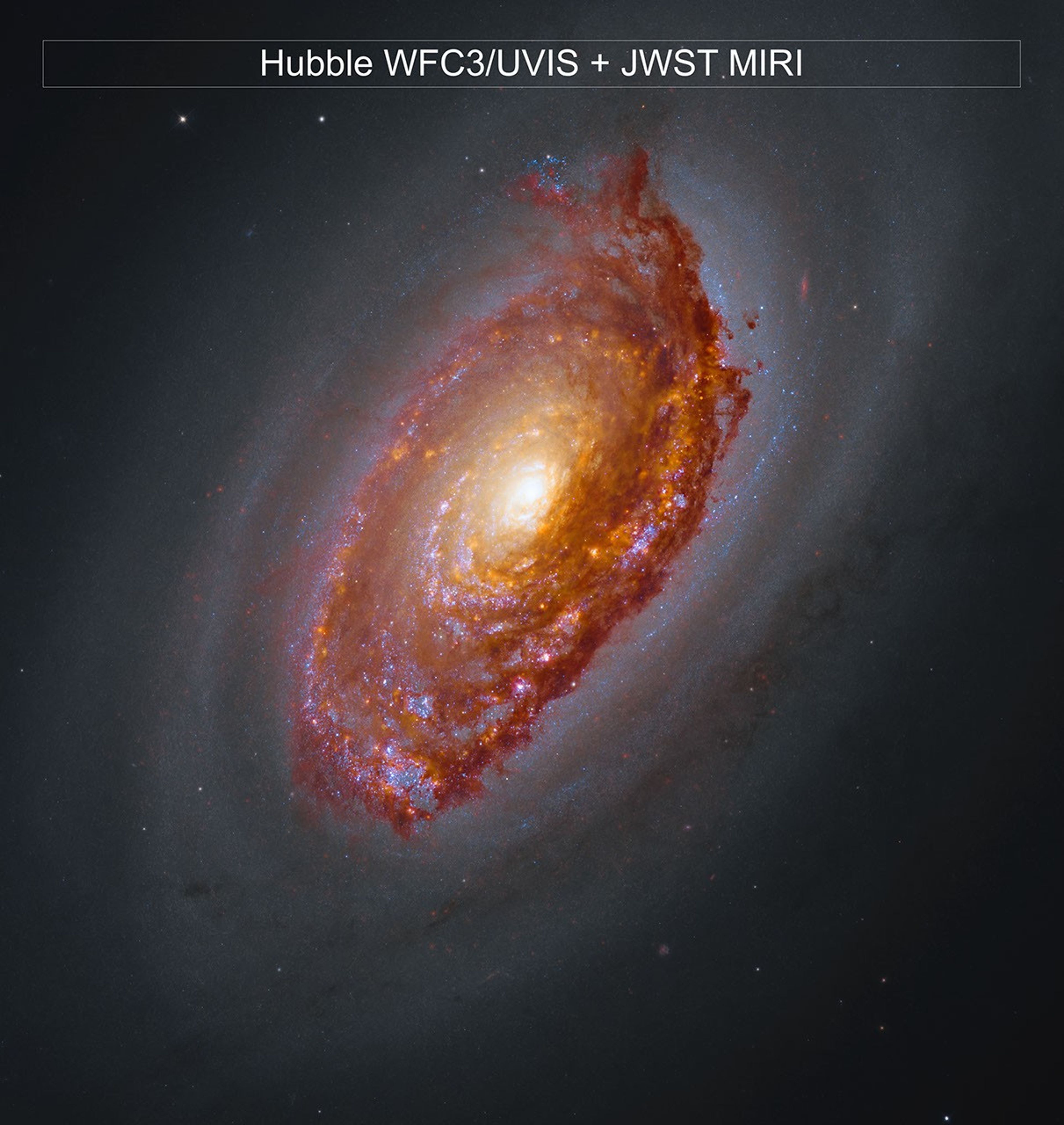
On September 16, 2026, the Astronomy Picture of the Day showcased a fascinating composite image of Messier 64, also known as the Black Eye Galaxy. This nearby spiral galaxy has long captured the attention of astronomers, as it presents a unique case where Hubble sees darkness while Webb discerns light.
The intriguing dark band visible in M64 earned it the nickname "Black Eye Galaxy." This feature is a dust lane partially obscuring the galaxy's bright core. However, Webb's Mid-InfraRed Instrument (MIRI) reveals a different perspective. MIRI detects the dust, showcasing it in red hues as it absorbs and re-emits light from newborn stars.
In contrast to Hubble's view, Webb's Mid-InfraRed Instrument (MIRI) captures the glow of young stars nestled within the dust lanes. These stars appear as pink regions in Hubble's image, which is limited to visible light.
M64's inner and outer gas regions are in motion, counter-rotating. This unique arrangement leads to increased star formation where the two gas currents intersect and compress. The possibility of a merger with a smaller galaxy likely played a role in the outer gas's opposing motion, providing astronomers with valuable insights into the galaxy's history and evolution.
Webb's observation of M64 holds significant importance for astronomers. The data collected will help researchers understand the structure, motion, and composition of the galaxy's dust. Additionally, the observations will offer context regarding the galaxy's merger history and evolution. As the main NASA site evolves, the Astronomy Picture of the Day remains a captivating source of knowledge and awe about our vast universe.
Written by urgent.news from NASA Science's reporting — not their text. Machine-written — may contain errors; check the original before relying on it.
Also reported by 1 other outlet
- APOD: 2026 September 16 – Webb’s View of M64 science.nasa.gov