Red Sea disruption puts global mining supplies at risk
GEM modelling flags acids, fertilizers, battery inputs and fuels as vulnerable to higher costs and shipping delays.
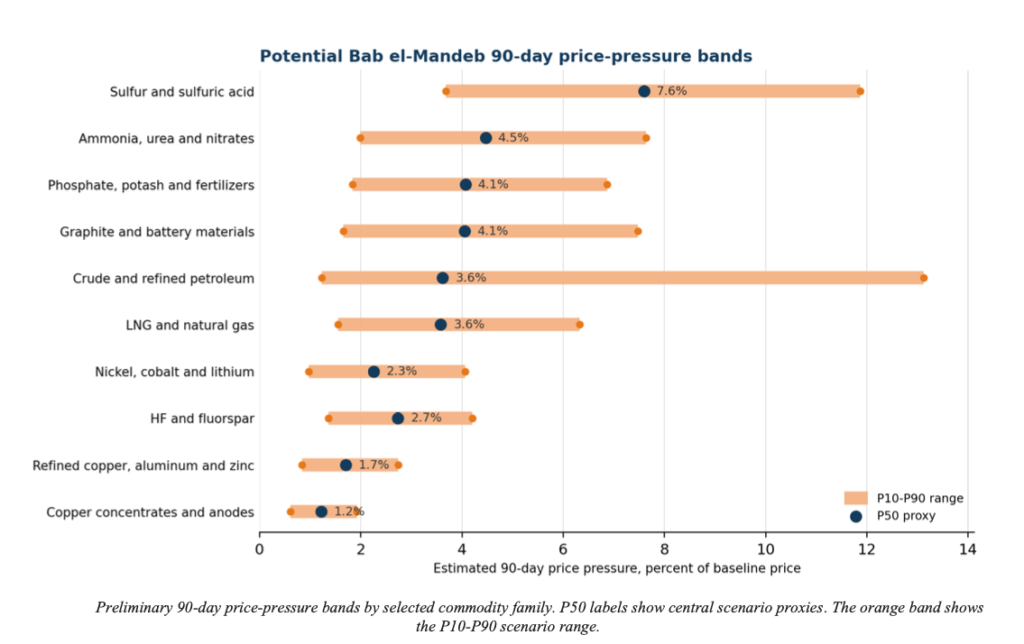
A prolonged blockade around the Bab el-Mandeb Strait, a critical chokepoint for Red Sea maritime traffic, could disrupt mining supply chains beyond oil and gas, potentially increasing costs and delaying essential inputs like sulfuric acid, explosives feedstock, and battery materials, according to GEM Mining Consulting, a Chile-based consultancy.
The company estimates that a 90-day disruption could impact 38.9 million to 77.8 million tonnes of commodities and inputs, with a central estimate of 61.1 million tonnes. Exposure to input delays could affect mine production from 0.8 million to 13.8 million tonnes, while delayed demand could range from 12.6 million to 33.7 million tonnes.
The value-weighted price pressure could fall between 1.2% to 10.5%, with a central estimate of 3.4%. Associated cost premiums could range from $480 million to $2.48 billion, with a central estimate of $1.37 billion. The assessment comes amid increasing control by Iran-backed Houthi militants over the Bab el-Mandeb region, which includes the Greater and Lesser Hanish islands, strengthening their position around the shipping corridor.
The Houthi advances have heightened concerns over the group's ability to disrupt maritime traffic in the region. The Bab el-Mandeb strait, located between the Arabian Peninsula and Africa, serves as the southern gateway to the Red Sea and is crucial for global trade, with approximately 10% of global maritime traffic passing through it.
The passage is vital for energy markets, particularly during conflicts in the Middle East, as Saudi Arabia redirects crude through the Red Sea to bypass disruption at the Strait of Hormuz. The Houthi advances have raised concerns over a potential oil supply crunch. However, GEM's analysis suggests that the consequences for the resources sector could extend further, affecting various commodities such as sulfur and sulfuric acid, ammonia and nitrates, phosphate and potash fertilizers, graphite and battery-material intermediates, petroleum products, and liquefied natural gas (LNG).
The vulnerability of these inputs stems from factors such as route dependence, limited short-term substitutions, and their significance to industrial processes. Some commodities may experience delayed costs, longer transit times, increased insurance premiums, and higher working-capital requirements rather than a global shortage of minerals.
Alternative routes and inventories might absorb some disruption, but freight costs could still rise due to shipping disruptions and limited inventories. Mining companies may need to treat maritime chokepoints as an operating risk, mapping shipping routes, stress-testing inventory coverage, and identifying backup suppliers and logistics options for critical inputs.
Governments could also incorporate strategic maritime routes into mineral-security planning by improving trade-flow transparency, customs and vessel-tracking data, port contingency planning, and international maritime surveillance.
Written by urgent.news from Mining.com's reporting — not their text. Machine-written — may contain errors; check the original before relying on it.