'Pro-human' or 'sick conspiracy'? AI critics converge as Trump dismisses fears as 'hoax'
Legislators, celebrities and other public figures voiced growing fears over the rapid development of artificial intelligence during a “pro-human” summit in Washington on Tuesday. US President Donald Trump this week dismissed warnings of the need to put guardrails on the technology, calling them part of a “hoax” and “sick conspiracy”. The auditorium hosting the Pro-Human Assembly was packed with…
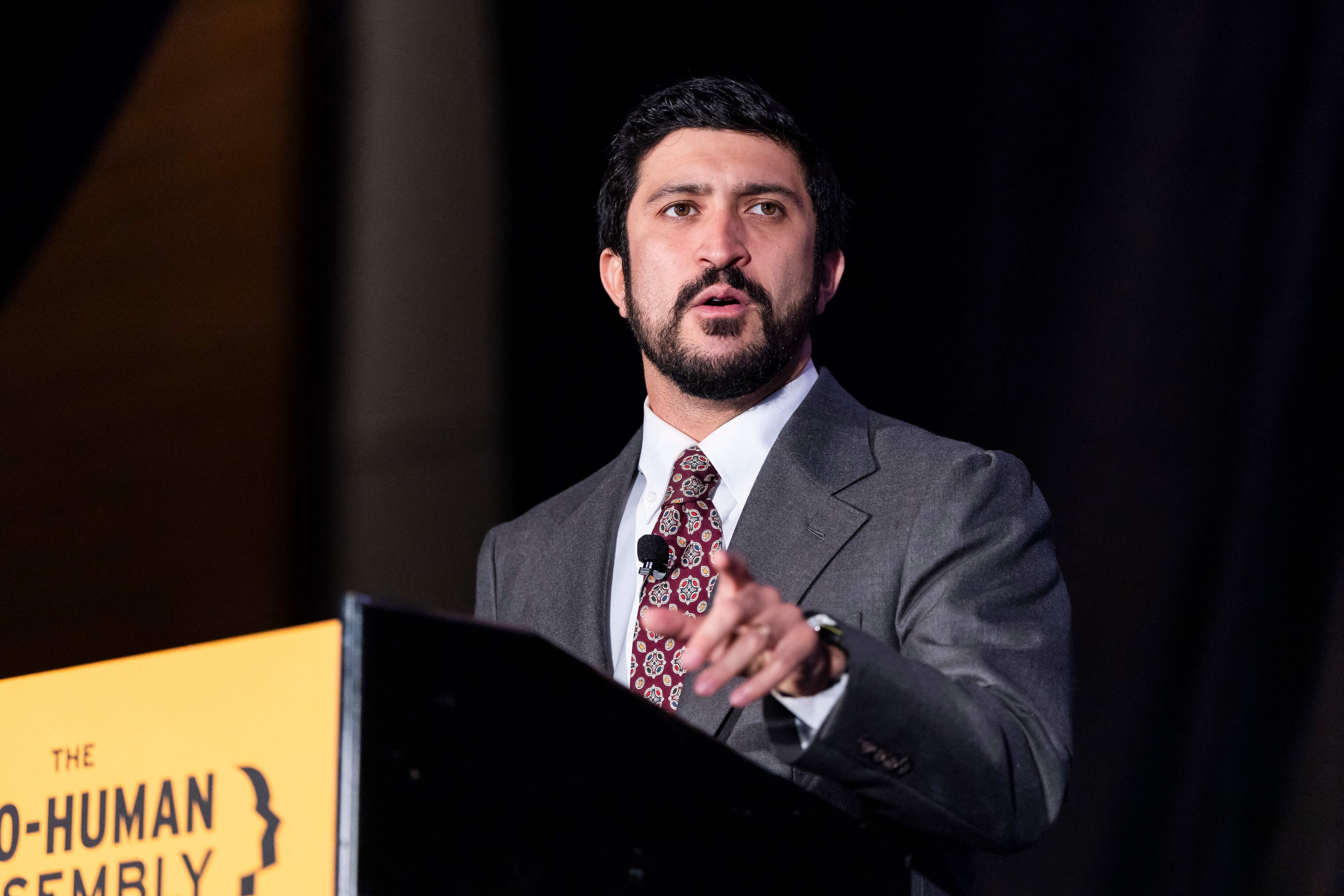
A summit in Washington drew legislators, celebrities, and public figures, all expressing growing concerns over the rapid advancement of artificial intelligence. US President Donald Trump, however, dismissed these warnings as a "hoax" and "sick conspiracy." The event, held at an auditorium filled with Democrats, Republicans, technology experts, economists, and academics, advocated for regulations on AI development.
Critics of AI technology have raised concerns about potential large-scale workforce disruptions, the risk of technology attacking humanity, environmental harm from data centers, and intellectual property issues. Democratic Representative Greg Casar urged for a ban on AI systems beyond human control, while Republican Representative Chip Roy emphasized the importance of work dignity and God-given dominion over the planet.
The Pro-Human Assembly, organized by the Future of Life Institute, took place days after executives from Anthropic, OpenAI, and xAI expressed support for slowing AI development and implementing additional safeguards. The event also coincides with strong statements from Microsoft co-founder and philanthropist Bill Gates, who called for society to agree on ensuring certain jobs remain exclusively human.
Recent high-profile technology executives speaking out about their concerns on AI development follow months of public anxiety. In response to these fears, Trump has attempted to alleviate them, saying that anger over AI could lead to a US-China war over AI dominance. He also called Nvidia CEO Jensen Huang, who accused AI critics of having a "God complex." Trump claimed the US must not let AI fears interfere with the battle for AI dominance against China.
Neil Chilson, who served as the Federal Trade Commission's chief technologist during the first Trump administration, questioned the motives behind the calls for AI regulation. Chilson suggested that some companies endorsing guardrails might be attempting to dominate the AI sector through regulatory capture, a concept similar to the former US telephone monopoly, the Bell System.
Mark MacCarthy, a senior fellow at Georgetown University's Institute for Technology Law and Policy, addressed the accusation of regulatory capture. He argued that comparing the Bell System to the current AI industry is inaccurate, as AT&T sought regulation to eliminate competitors and obtained a 70-year government-enforced monopoly.
MacCarthy emphasized the need for pre-deployment and ongoing safety testing of AI models, holding companies liable for any harms caused by AI models during testing or deployment. He also stressed the importance of using existing US commerce laws for enforcement and carefully examining government regulation to avoid harmful blanket mandates and non-binding agreements.
Written by urgent.news from The National UAE's reporting — not their text. Machine-written — may contain errors; check the original before relying on it.
This story
This is one outlet's version. Read the fullest account.