Prediction Market Odds Are Becoming News, but Their Context Is Getting Lost
Prediction market odds are entering news coverage without enough context. A study of 173.7 million trades shows why probability provenance matters.
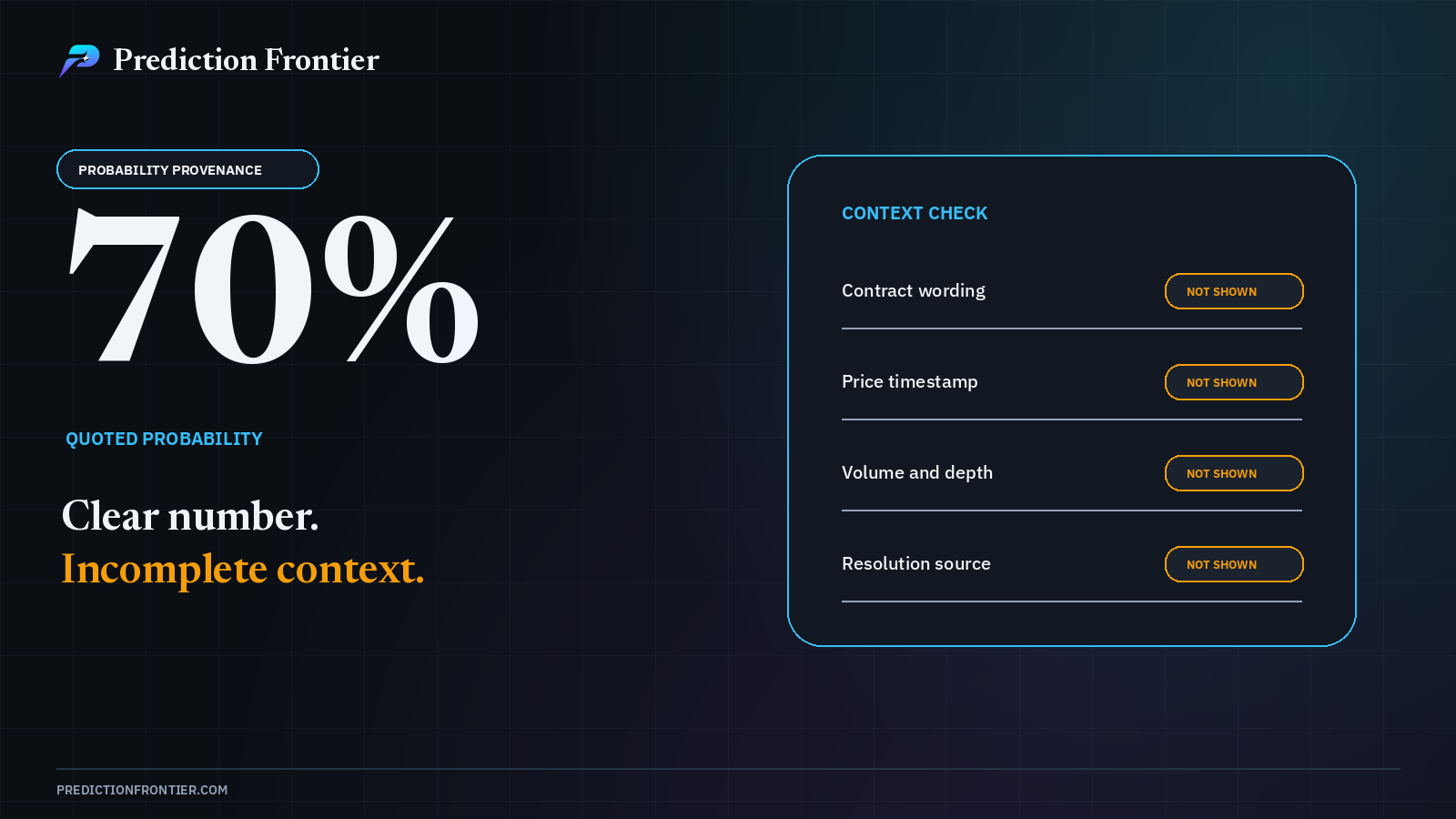
Prediction markets are growing in popularity, but the way their odds are presented is lagging behind. A 70 percent chance may seem straightforward, but it doesn't give the full picture of the contract, the time it was recorded, the volume traded, or whether it was driven by broad or concentrated interest. When these odds make it to the media, they are part of a larger package that includes the interface, editorial decision, and the channel used to reach a wider audience.
This can spread their reach but also strip away important context to understand them. This issue came to light recently when The New York Post reported that The Athletic ended a partnership with Kalshi while keeping advertising options open. Staff were concerned about maintaining editorial independence, though those worries did not directly cause the decision.
The story today highlights the expanding reach of prediction markets, shifting editorial lines, and questions about the reliability of these odds as they get public exposure. A new study by Hazem Ibrahim and Yasir Zaki provides some insight into this situation. Using data from 173.7 million trades on Polymarket, they analyzed 6,990 articles and 44,976 significant price changes across 9,590 markets in 2024 and 2025.
They defined a significant price shift as a change of at least five percentage points driven mainly by trading in one direction. They then looked at how news coverage followed these shifts compared to periods without such changes. Markets saw a 33 percent higher chance of being mentioned in the news after a significant shift. Most of these mentions happened after the price change, not on the same day, and about 27 percent appeared more than a day later.
Even when the analysis excluded articles published on the same day as the shift, the increase remained at 27 percent. The study doesn't prove that price movements directly caused the coverage or that anyone manipulated the market. It just shows that a noticeable shift in price often leads to more coverage. This can create a feedback loop where a big price change draws attention, bringing the probability to more people, which can then lead to more trading activity and more chances of future coverage.
Larger and more prominent markets need more trading activity to move their prices by five percentage points. The median shift grew from around $5,200 in less prominent markets to $56,900 in the most prominent, an elevenfold increase. However, these prominent markets are also much more likely to be quoted in the news. So while smaller markets might be easier to manipulate, prominent markets have a much better chance of their odds getting widespread media attention.
This creates a distinction between less well-known markets, which are harder to move, and prominent markets, which, although harder to shift, have a much higher likelihood of their odds being reported. The researchers call this relationship "epistemic leverage." In simple terms, it compares the trading activity tied to a price change with how likely it is that the resulting probability will be reported in the news.
The point is that having a lot of liquidity doesn't tell us how influential a market can become. We also need to ask: once a probability leaves the platform, how far will it travel and how much authority will people give it? Prediction markets can quickly aggregate information and reveal changing expectations before slower indicators catch up.
But to make sure their prices remain credible as they spread, we need to treat the reported odds as data with a clear provenance, not just as a standalone fact. The next step in media distribution will involve treating those numbers as data with a provenance trail, answering questions about where the market is, what conditions are needed for a "Yes" outcome, when the quoted price was captured, what recent trading volume and depth are behind it, how large the latest shift was, and who ultimately decides the outcome.
Written by urgent.news from HackerNoon's reporting — not their text. Machine-written — may contain errors; check the original before relying on it.