Long-term sectoral growth patterns: What should we focus on?
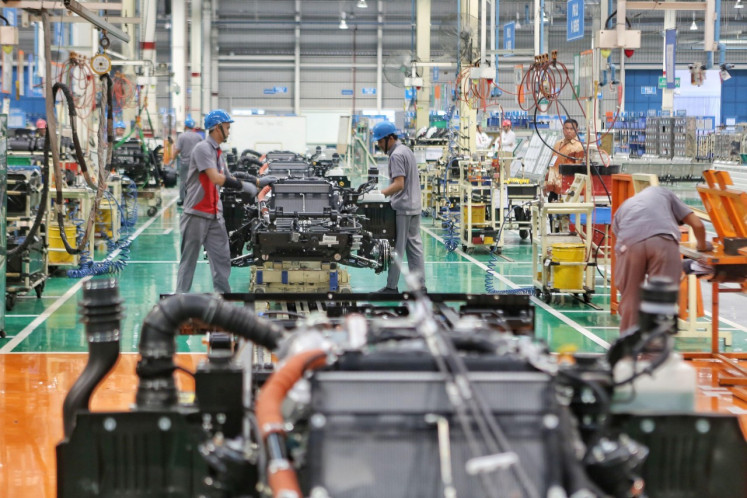
In recent years, the manufacturing sector's contribution to the economy in several Southeast Asian countries, such as Indonesia, Thailand, Malaysia, and Singapore, has been declining, while Vietnam has remained an exception. This discrepancy between the conceptual prediction and empirical evidence has raised questions about the reasons behind this shift and its implications for Indonesia.
Several factors may explain the decline in the manufacturing sector's contribution to the economy. Firstly, modern manufacturing firms increasingly provide services alongside goods, particularly after-sales services. For instance, consumers now consider factors such as the availability and quality of after-sales service when purchasing a car. Consequently, manufacturing more products may drive services.
Secondly, consumer preferences are shifting towards accessing services rather than owning durable goods. With the advent of per-trip ride-hailing, short-term rentals, and longer-term subscription plans, people can enjoy the benefits of durable goods without owning them. This trend, particularly among younger consumers such as Gen Z, favors spending on experiences like travel, which supports tourism-related businesses such as hotels, restaurants, transportation, and leisure services. Consequently, services may grow faster than manufacturing.
Lastly, these factors collectively indicate a normal structural transformation driven by rising consumer demand for services and experience-based spending. In such cases, a shift towards a service-led economy is generally considered a healthy development, as services tend to expand more rapidly than manufacturing, which focuses on producing physical goods.
However, some analysts argue that a sustained, widespread decline in manufacturing's share of output and employment should be viewed as deindustrialization. Notably, Indonesia's manufacturing sector's contribution to GDP remains substantial at 19.1 percent in 2025, but its growth has lagged behind national GDP growth, causing its share of GDP to decline over the past 15 years. Despite this, the sector continues to be a significant employer, accounting for 19.6 million workers as of February 2025.
Investigation into the manufacturing sector reveals that growth performance varies when examined at the subsector level. Export-oriented industries like electronics, garments, footwear, leather goods, and furniture experienced strong growth in the past two quarters of 2026, driven by a recovery in global economic growth and trade tensions between the United States and China.
However, these industries are sometimes criticized for declining due to rising production costs, particularly wages, outpacing productivity. Nonetheless, labor-intensive industries still make a substantial contribution to exports and absorb a significant share of the workforce.
On the other hand, domestically oriented industries like machinery, transport equipment, food and beverages, chemicals, pharmaceuticals, rubber, tobacco, paper, and oil and gas refinery also grew strongly, supported by a robust domestic market. Meanwhile, agriculture, despite remaining a crucial pillar of Indonesia's economy, has shown weak growth due to falling productivity, raw material shortages, limited land, and structural headwinds such as small domestic reserves, inadequate refining capacity, and restrictions on ore mining quotas. The basic metals sector, particularly nickel, is also pressured by these limitations.
In summary, the decline of the manufacturing sector in several Southeast Asian countries, particularly Indonesia, can be attributed to factors such as the increasing importance of services, shifting consumer preferences towards experiences, and a shift towards a service-led economy. At the same time, certain manufacturing subsectors have experienced growth due to changing consumption patterns and an expanding domestic market.
Policymakers should focus on reindustrializing export-oriented industries and supporting domestically oriented industries to address the challenges faced by the manufacturing sector.
Written by urgent.news from The Jakarta Post's reporting — not their text. Machine-written — may contain errors; check the original before relying on it.