India’s strategic autonomy faces a trade test as WTO warns non-aligned economies could pay a price for fragmentation
India's foreign economic policy aims for broad trade ties. The WTO warns of rising costs in a fragmented global trade system. India's numerous free trade agreements offer preferential market access. Diversification and multiple pacts help maintain economic flexibility. This strategy counters rising trade costs in a bloc-driven world.
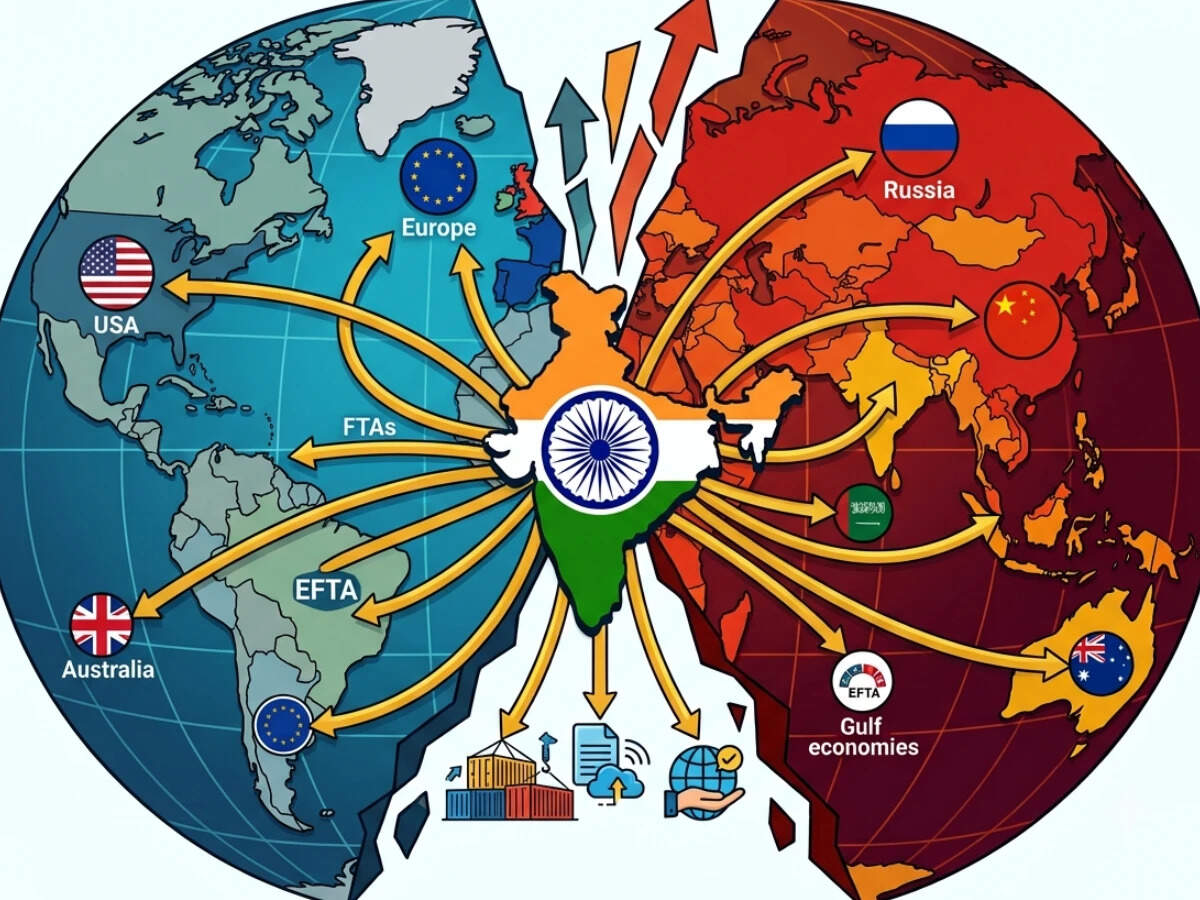
India has long pursued a foreign economic policy that allows it to maintain relationships with key global powers, including the US, Europe, Russia, and China, while remaining flexible to engage with platforms such as BRICS and the Global South. This approach has helped India expand its trade footprint. However, the World Trade Organization's latest assessment raises concerns about the impact on countries that do not align with any particular geopolitical bloc in a world where trade is increasingly organized around such divisions.
The WTO's 2026 report does not categorize India as a "non-aligned economy," but it models potential scenarios where the world is divided into western and eastern blocs, along with an economic group outside these camps. In such a scenario, the tariff "water," representing the gap between applied and legally bound tariff rates, could rise by up to 25% between the western and eastern blocs and by up to 10% between the non-aligned group and either bloc, assuming no free trade agreements (FTAs) exist. Additionally, trade costs would rise between blocs and non-aligned economies lacking agreements.
For India, which is negotiating and implementing trade arrangements across major economic blocs, the WTO's findings suggest that having preferential access to multiple markets may hold greater economic value before geopolitical lines become more defined. India has been actively pursuing FTAs, including a landmark agreement with the European Union (EU) in January, as well as agreements with the UK, Australia, EFTA, and other partners.
The EU contributes significantly to India's trade with 11.1% of its total trade in 2025, while the EFTA pact offers comprehensive market access for 92.2% of tariff lines, accounting for 99.6% of India's exports.
Despite these efforts, India faces challenges as its trade numbers demonstrate a strong reliance on key markets such as the US and China. The country's total exports reached $863.1 billion in FY26, with $441.8 billion in merchandise and $421.3 billion in services. India's ties with China have grown, with goods trade amounting to $155.6 billion in 2025, with imports from China totaling $132 billion.
This creates a central tension for New Delhi as it seeks diversified markets without being forced into a binary choice between the US-led and China-led economic systems.
The WTO's warning primarily focuses on trade costs rather than diplomatic neutrality. The report indicates that many middle-income economies would be vulnerable, belonging to either the eastern bloc or a group of non-aligned economies without FTAs, leading to higher trade costs across a larger portion of their trade. While the WTO does not argue for formal bloc membership, it highlights that geopolitical alignment can increasingly determine the commercial cost of crossing borders.
This matters to India because its ambition extends beyond selling more goods abroad; it seeks to insert itself into global manufacturing and services supply chains, encompassing electronics, pharmaceuticals, engineering goods, and digital services. As these networks become more fragmented, predictable access to several large markets becomes increasingly valuable.
India's recent trade diplomacy may be a response to the WTO's scenario. With merchandise exports reaching $441.8 billion in FY26 and non-petroleum exports at $387.9 billion, the government emphasizes India's diversification of export destinations as a source of resilience. The Economic Survey 2025-26 notes that India ranks third among Global South economies in trade-partner diversification, with global merchandise exports nearly doubling from 1% in 2005 to 1.8% in 2024.
However, diversification alone may not suffice if trade rules increasingly align with geopolitical allegiance.
India's strategy of pursuing multiple FTAs with the EU, UK, Australia, EFTA, and Gulf economies, along with continued engagement with BRICS and Russia, provides options to access various major markets. During the New Delhi BRICS summit, the group expressed concerns about unilateral trade restrictions, voicing serious objections to measures that distort trade and contradict WTO rules.
India aims to capitalize on the benefits of Western markets and investment, leverage manufacturing and supply-chain opportunities by reducing its dependence on China, and maintain economic relationships across the wider Global South, all while avoiding any single geopolitical camp from dictating its trade choices.
Written by urgent.news from The Economic Times - Economy's reporting — not their text. Machine-written — may contain errors; check the original before relying on it.
Also reported by 1 other outlet
- Trade fragmentation could hit poor economies much harder than rich ones, WTO warns economictimes.indiatimes.com